(This post is a bit out of sequence. I actually did this work before going on to pull the engine.)
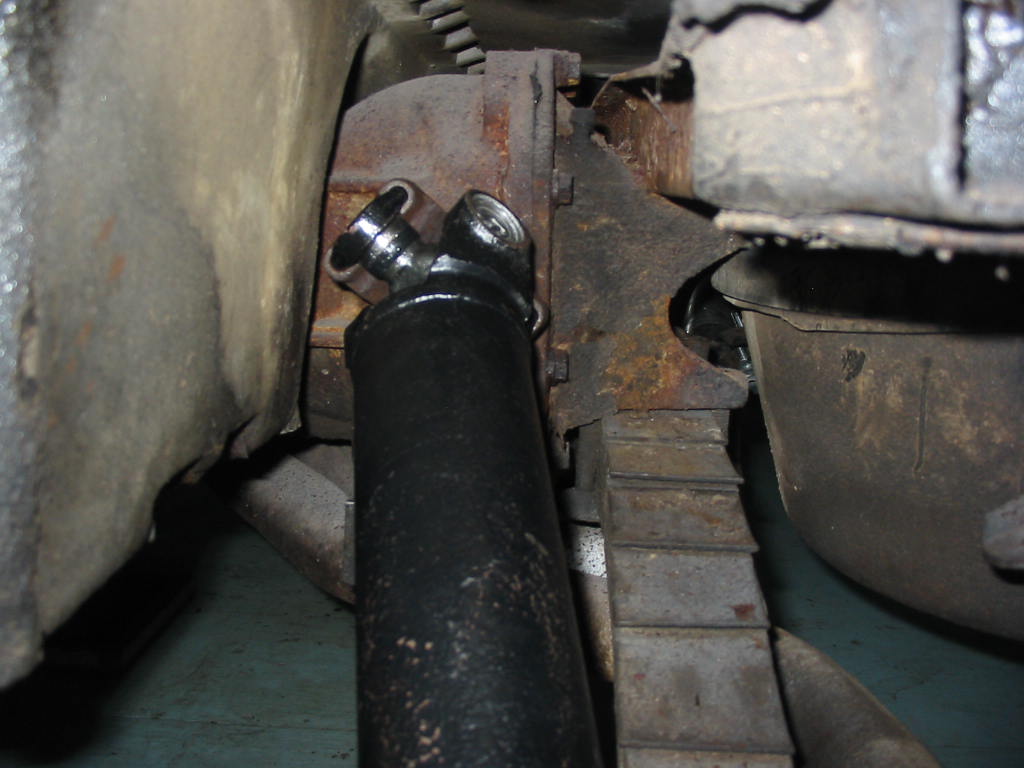
Very hard to get the short shaft u-bolts in place and tightened. No way to get a torque wrench in place for final tightening. So I tightened them as I always did in the old days – a good pull on a regular wrence, but not overly. I put blue lock-tight and new lock washers on all of the u-bolt arms.
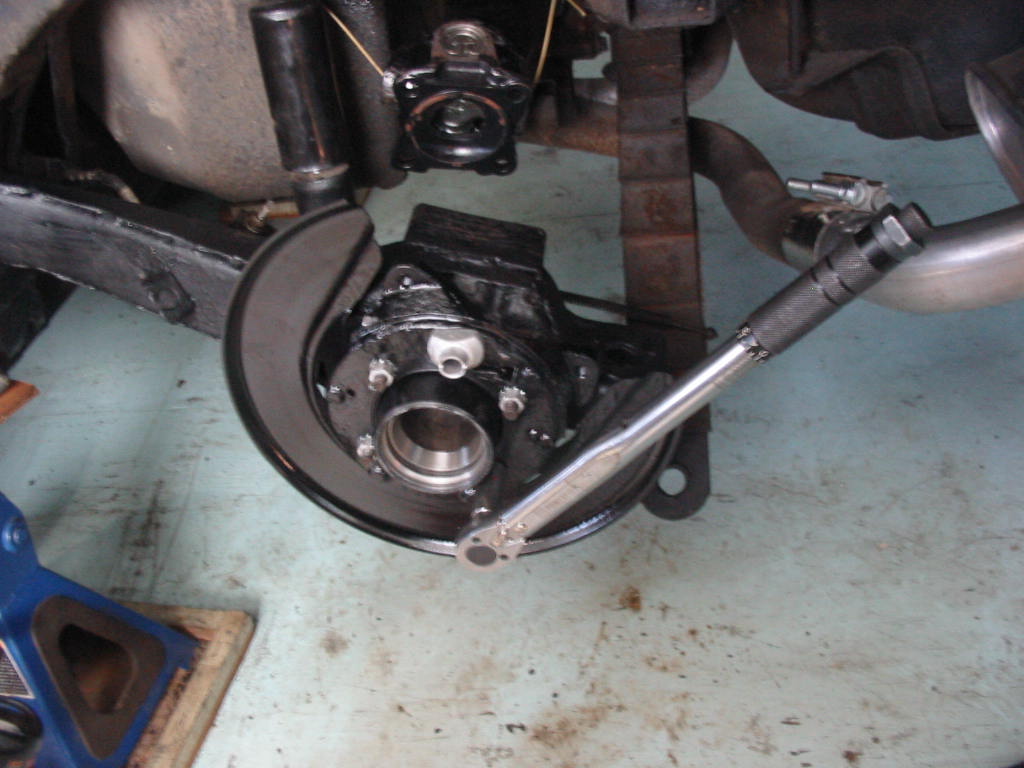
Spindle support and parking brake flange in place with nuts torqued to spec – 30 Ft Lbs.
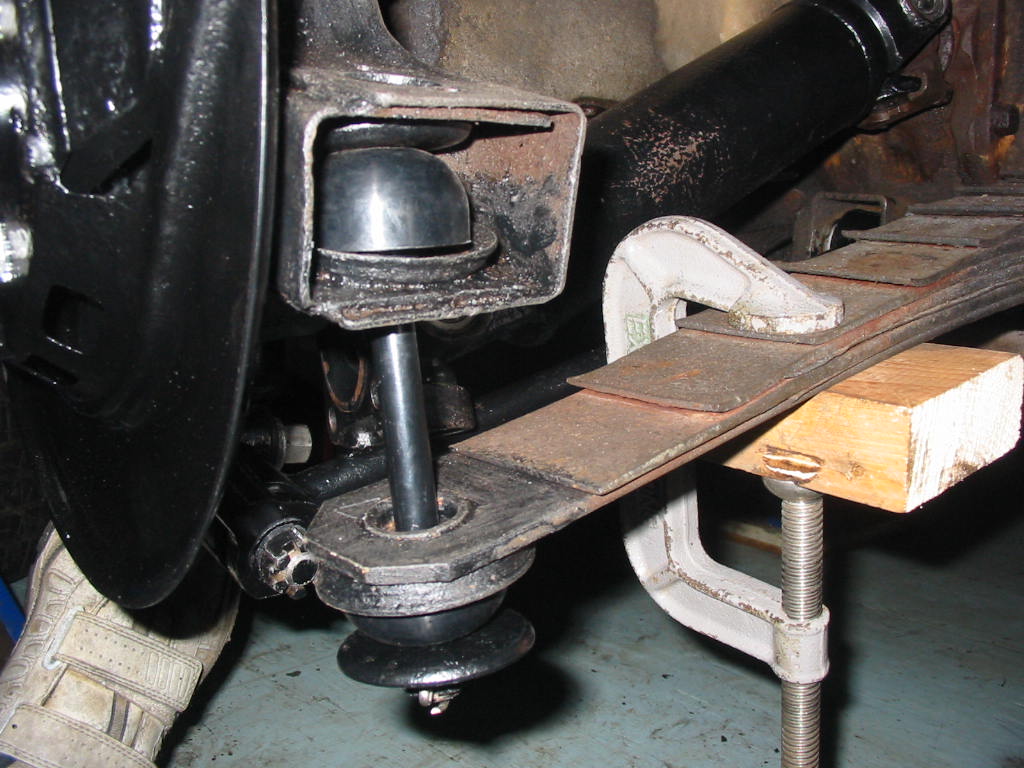
New plastic bushings in place. A real trick to get them on. I had to jack the spring up until the car started to lift then use a 2 X4 to press down the trailing arm enough to get the lower washer and bushing in place. I also had to disconnect the shock and remove the strut bolt before the trailing arm would lower enough.
Next: I’m waiting for parking brake parts so I will have to leave the rear suspension for a bit. Now I can get back to the engine swap 🙂
I’m using a lift plate rather than my adjustable lift tool as I don’t know how much room I’ll have to fully lift the engine over the body. Not like a regular body where I can remove the rad and grille and not have to raise the engine too much to get it out.
Engine out and high enough to slip over the front. The long exhaust flange studs were a bit of problem getting over the exhaust pipe. Won’t be a problem when I put in the donor engine as it won’t have the exhaust manifolds attached.
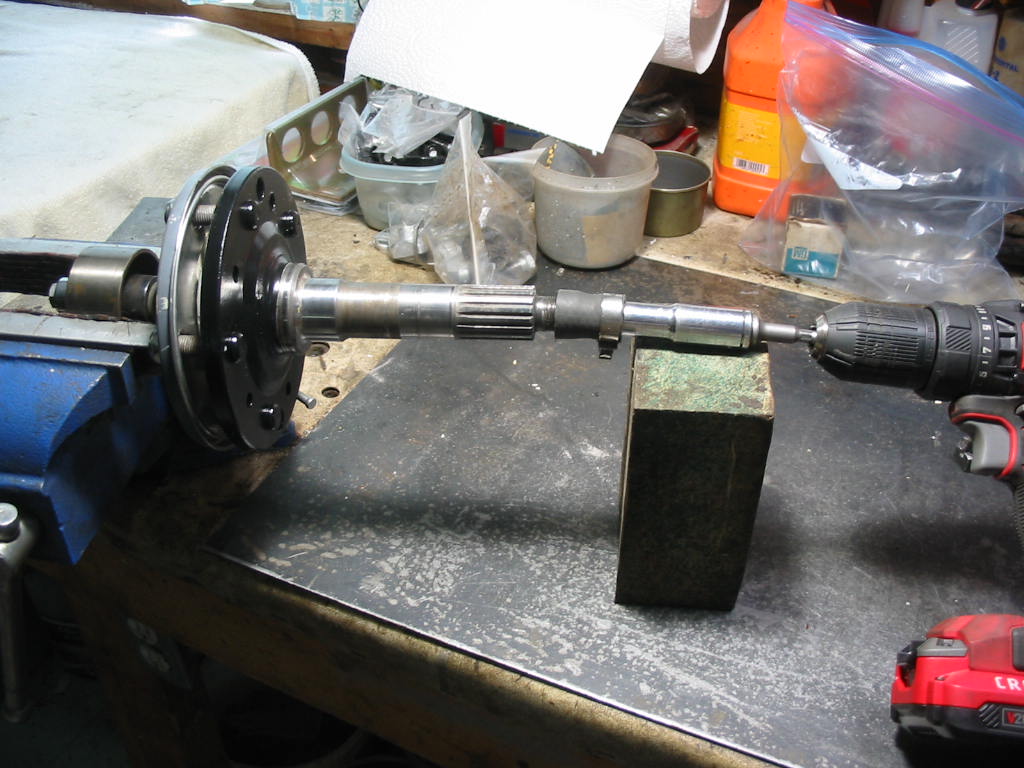
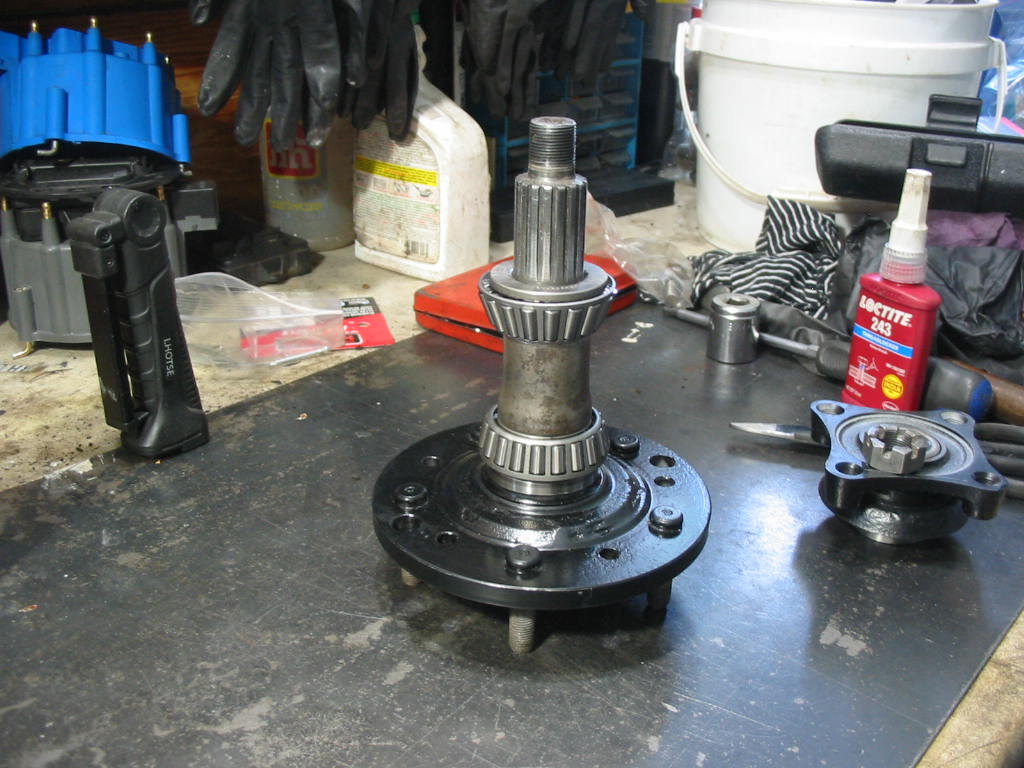
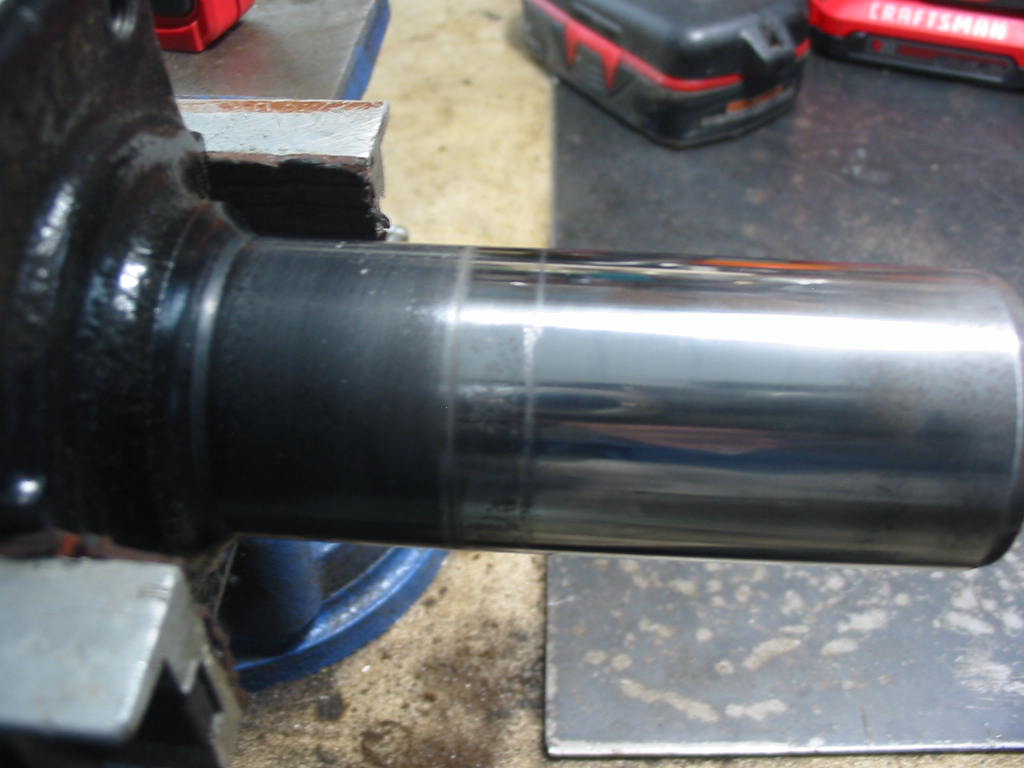
This is the rig I borrowed from a fellow C3 Corvette owner Barry Chappell. Going from the left is an idler bearing which is attached to a paint can top with holes to take the spindle studs. The spindle is attached using regular studs put on backwards to flush up against the paint can lid. The drill is attached to the spindle with a short length of coolant hose and a long 1/2″ drive socket on the other end. Then an adapter to fit sockets to a drill. I ran the drill slowly and held a wrapping of 80 grit paper on the bearing surface. I sanded a bit and then checked the fit until the bearing just fit over the spindle snugly. Caution is needed here because it is easy to turn the spindle down too much and that would result in the spindle needing replacement or a sleeve installed – both an added and unnecessary cost.
Spindles taken down and bearings slip fitted on.
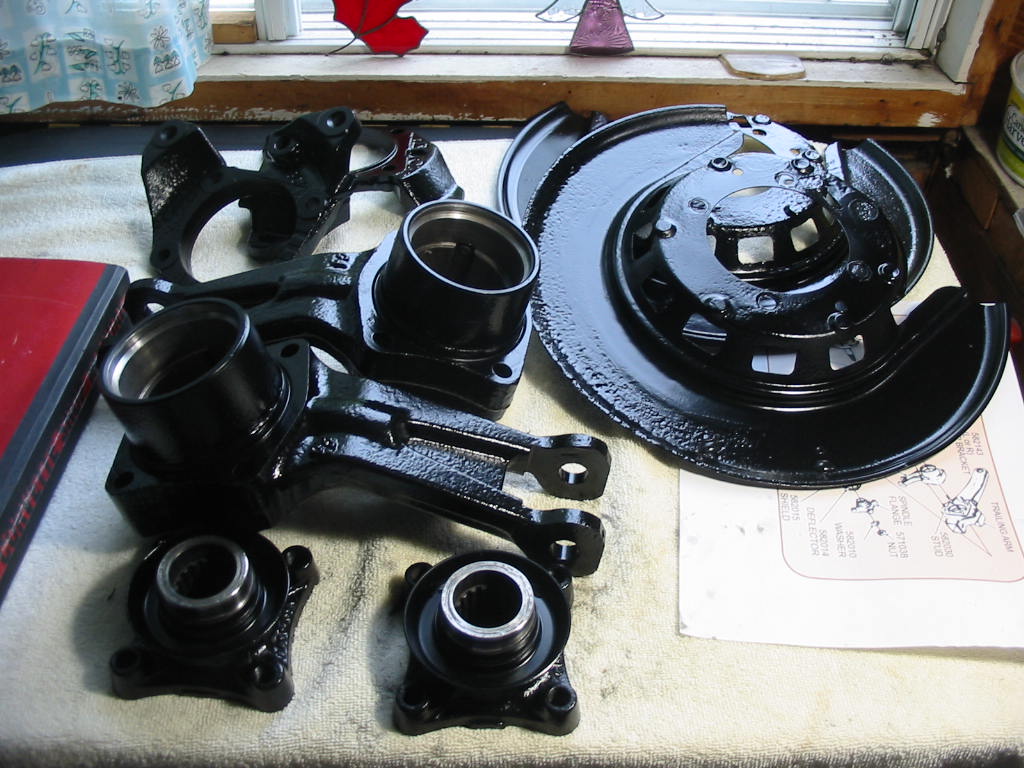
Parts with primer and two coats of semi-gloss Tremclad oil based metal paint.
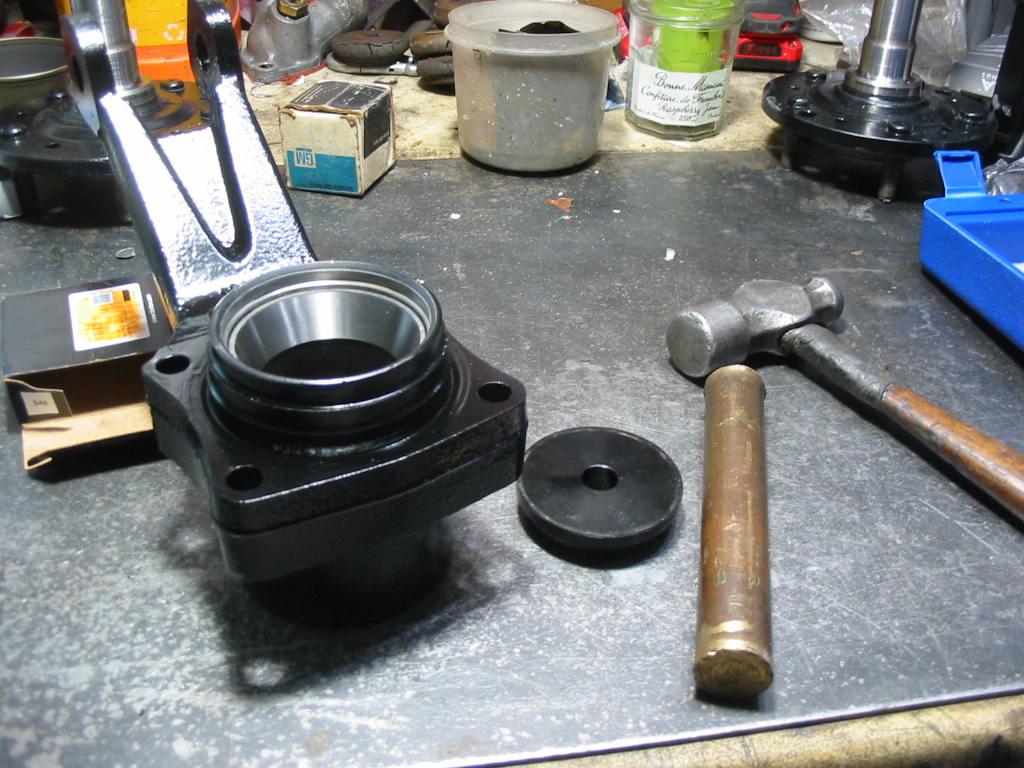
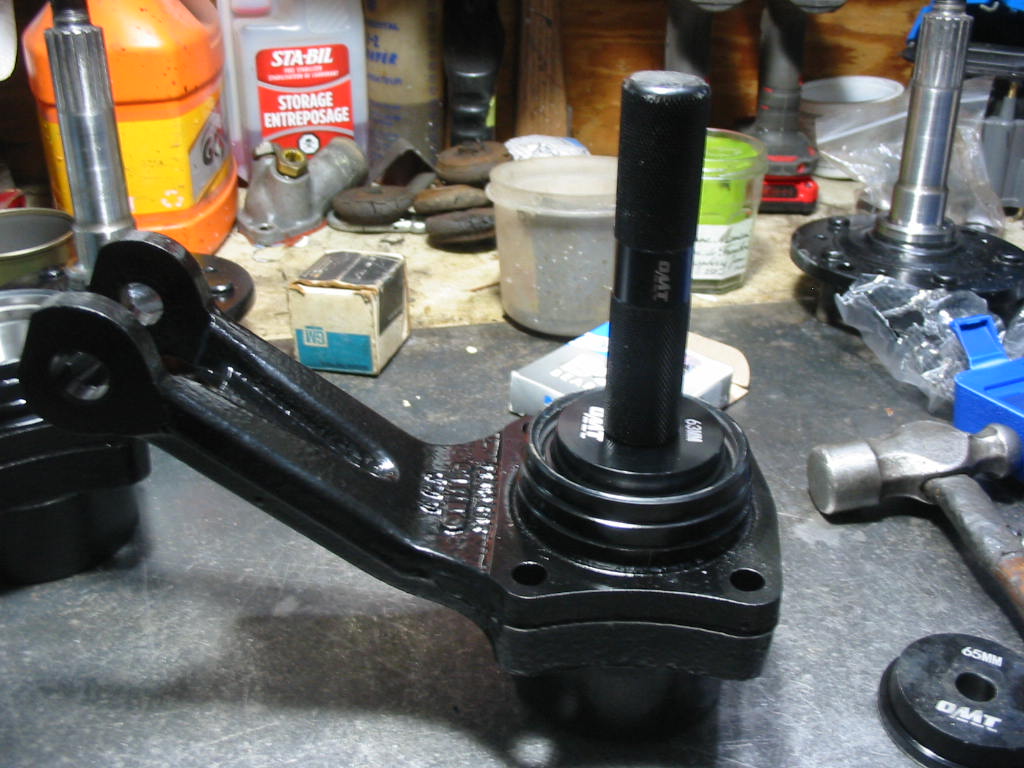
I got the races (cups) started with hammer and brass drift. I then used my bearing and seal seating tool to get them seated tightly. I picked up a seating tool awhile back, but for some reason it is metric. So I just chose one that fits flip it over and use it that way.
Friend Barry was also able to supply a selection of shims and two spacers.
It was then a matter of selecting a combination of shims and spacers that would give me a spindle play of as close to .001 as possible without going below the minimum. On one side I had to flat sand a shim and a spacer to get the play down to were I wanted.
Using my dial gauge and the bench vise I kept trying combinations of shims and spacers. I was able to get a reading of between .001 and .002 which is OK for me. The manual says it can be as high as .008, but that would be really sloppy.
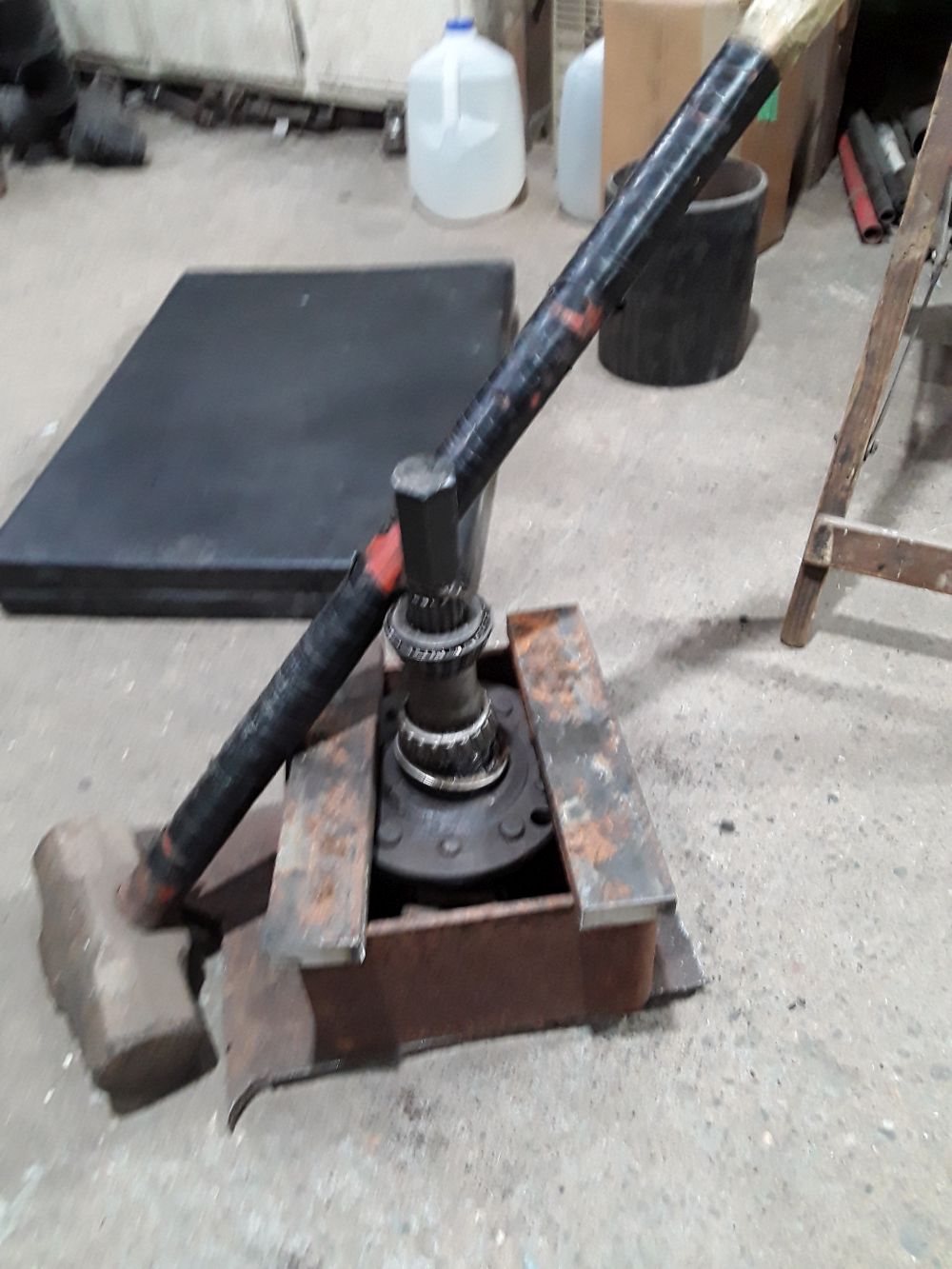
The large manual press just couldn’t move the spindle. The spindle was suspended in the metal box as you can see. The two thick steel plates just fit between the spindle flange and the parking brake backing plate (missed getting a shot of that). I bought a big nut for the top of the spindle from Corvette Depot. It is designed to protect the spindle threads and provide a solid surface to hammer on. In this situation it took a 10 lb hammer and some serious hits to finally break the spindle free. We then used a ‘cheese cutter’ under the outer bearing and the sledge to break it free – it also took a few good blows to get it off. The spindle threads were not damaged at all. We did put a couple of spacer washers under the big nut so that it was pressing on the spindle collar under the threaded section.
The bearings were all lightly “boxed” and this one had a serious pit and that needed to be replaced. Lots of old grease in the bearings and they might have gone quite a way before causing problems but this unit would have become more noisy.
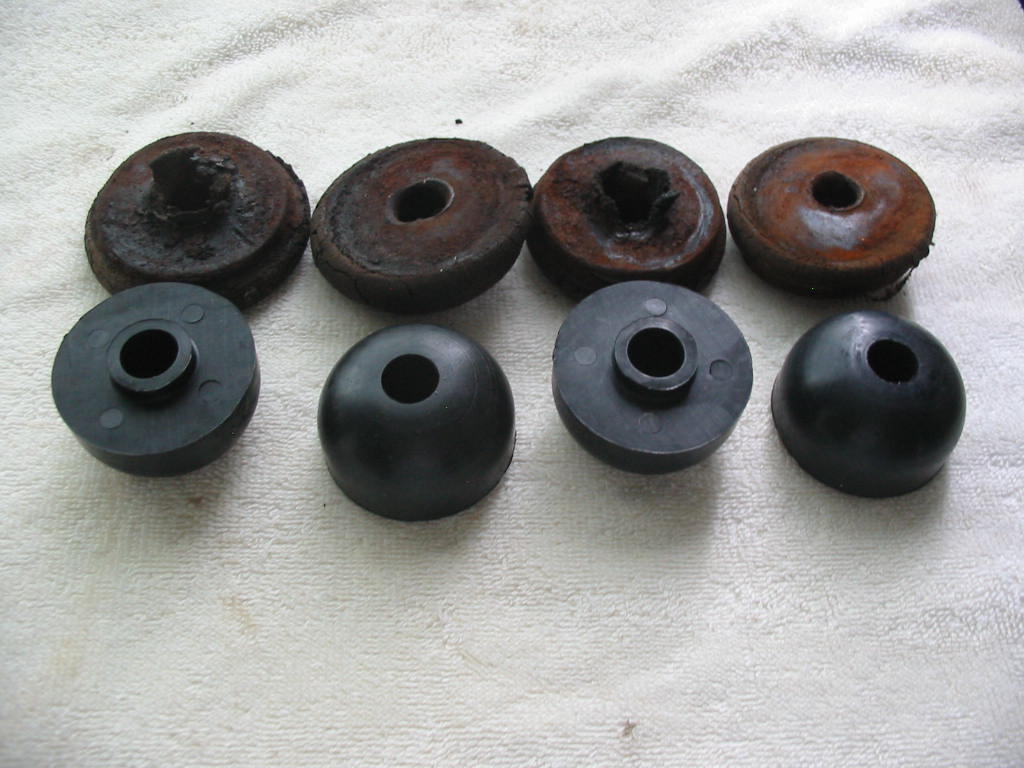
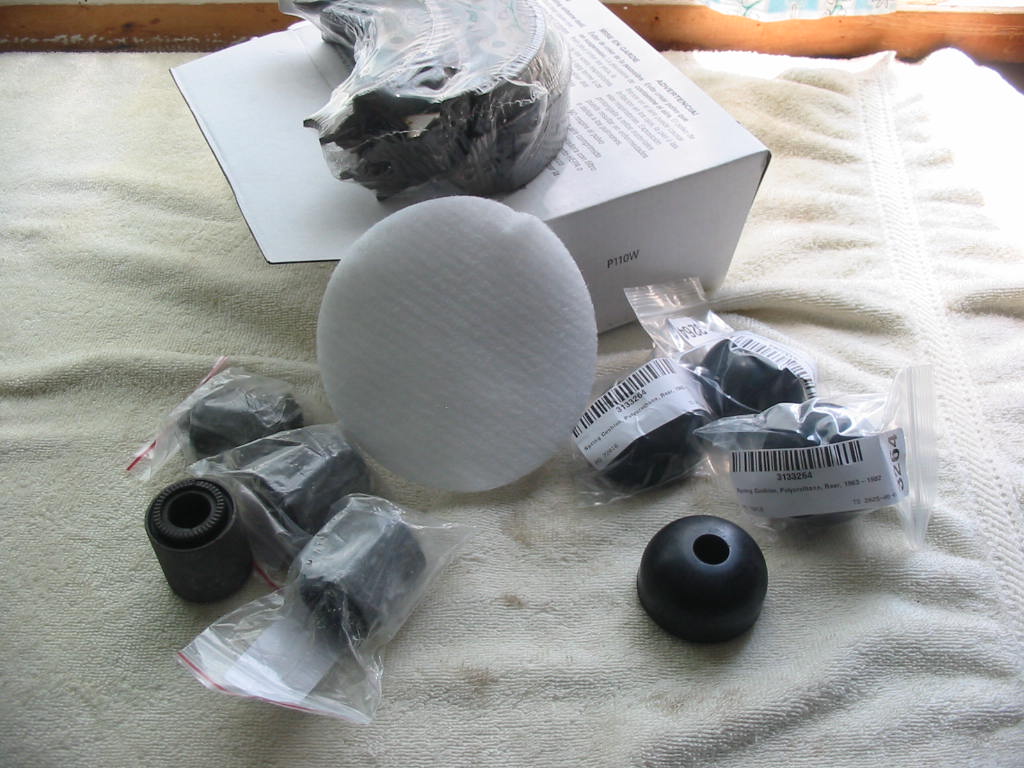
These new polyurethane bushings should return the rear end to the proper stance. I would have preferred rubber cushions, but these are all that Corvette Depot had on hand. I’m told these plastic cushions can squeak so I’ll give them a coat of fluid film when they go in.
The spring has likely sagged a little over the years, but the car still stands level so I can go with that. At some point I will remove the spring and put in new plastic liners.
Trailing arm looking a lot better with a coat of rockerguard. I’ll clean up the contact area for the spindle support and then give that area a light coat of Fluid Film to stop any corrosion between the surfaces.
All glass bead blasted. I don’t use sand any more. I find the bead blasting leaves a nicer surface for painting – not so much sanding needed.
There are some heavily pitted areas on the parking brake flange plates. I have given them a coat of epoxy to seal and strengthen them. Now on to painting.
New bearings and seals for both spindles.
Next; turning down the spindles so the bearings will be a ‘slip fit’ rather than needing to be pressed on.
The last parts to be replaced are the spring cushions. These are pretty well at end-of-life.
The jack is held in place by the short piece of 2X4 clamped to the spring.
I was careful in removing the bolts holding the spring cushions. Fortunately they are grade 8 bolts and took the strain of getting the old rusted on castle nuts off. I used lots of penetrating oil to help things along. Cleaned and sandblasted above and ready for paint.
I’ve let the leaf down so I could use the jack on the other side. It is a bit tricky jacking the spring as it lifts the car off the rear jack so I needed to watch that it settled back down right. Easy now to clean and apply rocker guard to the trailing arm and spring ends. Rocker guard is tar like and doesn’t seem to mind any bits of old oil or grease still on the part. It works well on a-arms and other under body metal that is not visible.
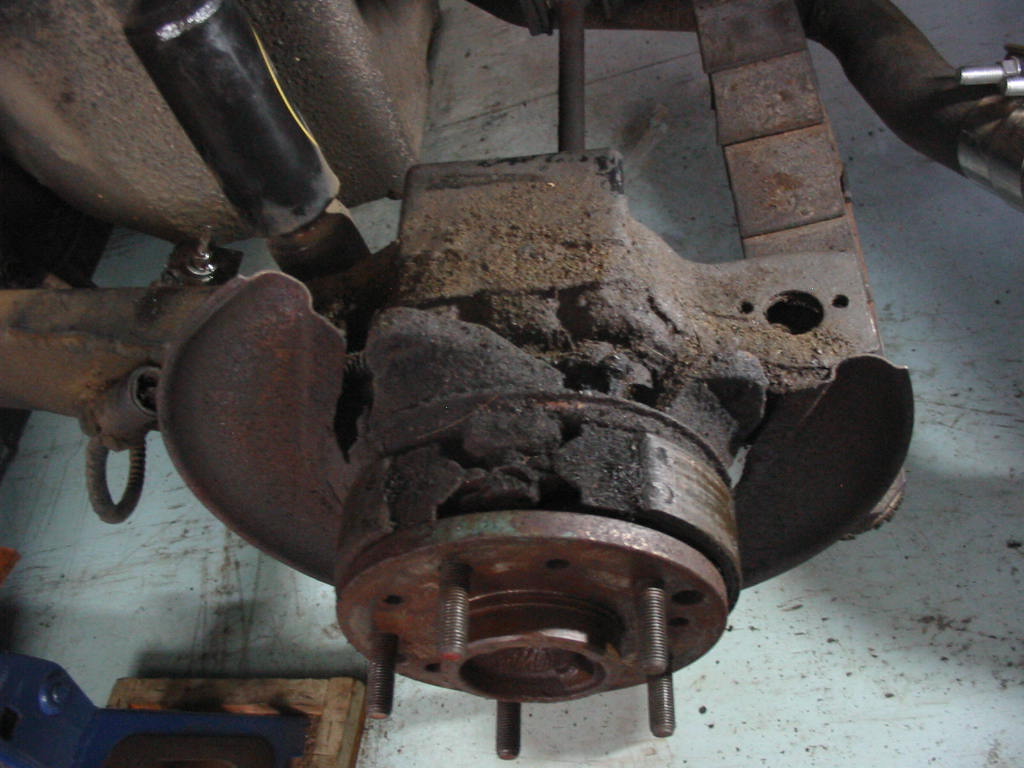
The parking brake bracket on the right side was bent and broken off on the bottom. I’m no welder, but I can get a bit of weld on spots like this. As you can see by all the welding spatter the trailing arms are not welded very nicely at the factory. Maybe these are not normal.
The new bushings show just how bad the old bushings had gotten. Ive been told that the harder polyurethane bushings can squeak so I’ll give them a light coating of fluid film on assembly and hopefully that will be enough.
Coated in rocker guard. Brushed on so not as smooth as spray, but the arm is pretty rough itself so no matter really. I”ll clean away any rocker guard on the mating surface for the spindle support and then apply a coat of fluid film when I put it together.
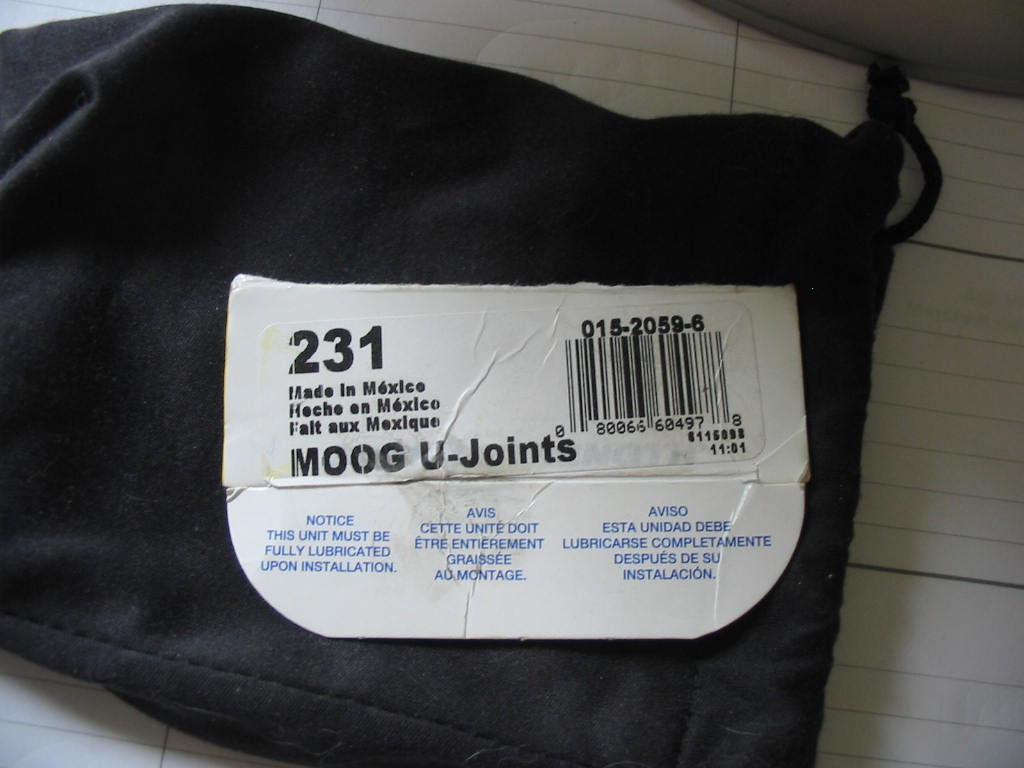
One should always read the fine print. My first time installing non-greaseable universals so I assumed that the cups were all loaded with the proper amount of grease. When I had done the job I noticed this tiny note on the universal box flap. No information slip in inside, just this little easily missed note. So no option but to remove all six universals and get them greased.
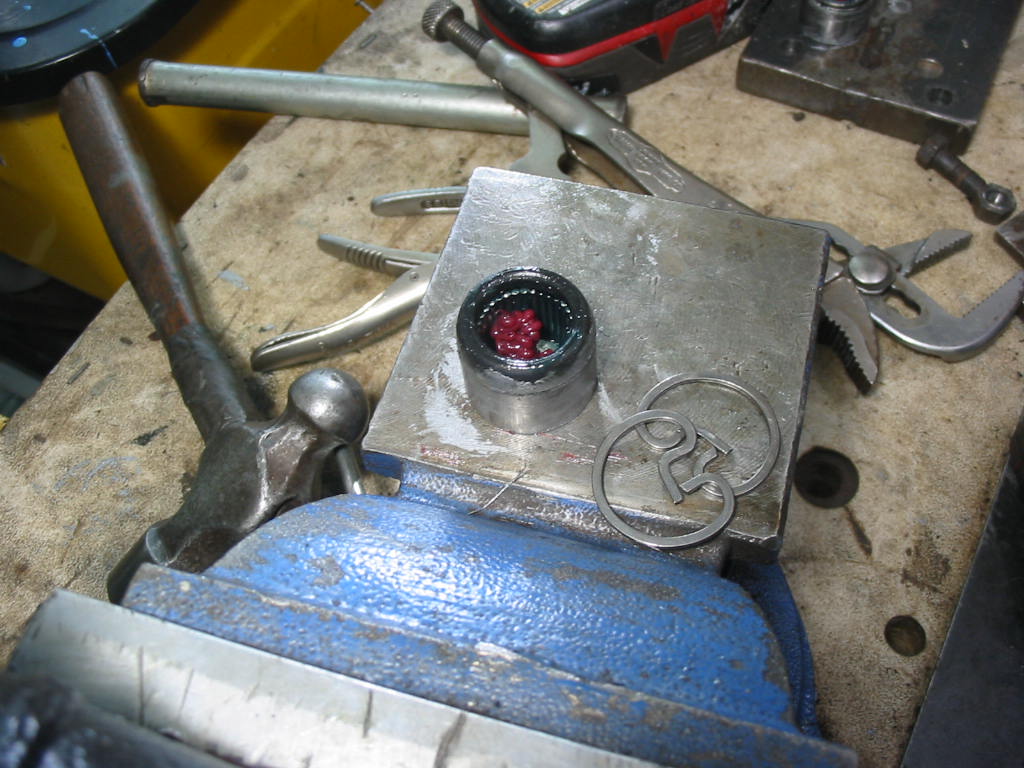
Not the easiest thing to do to get the new cups out of the yokes. The set that I had greased with anti-seize earlier came out the easiest. I’ll install them with a little grease to ease going in. I squirted one pump from the grease gun, loaded with wheel bearing grease, into each cup.
I also filled the blind holes in each cross arm. I used a needle applicator on the grease gun.
Both short shafts done. I had problems with the flanges bending – even with a 1/4″ steel plate attached – on the last install, but this time all went well after I tighten the plate to the flange good and tight. Only the main drive shaft to finish and hopefully I won’t break either universal. l broke one short shaft universal on the first install and had to buy one from CarQuest. It cost about $53 whereas the ones I purchased from Rock Auto were $35 including shipping.
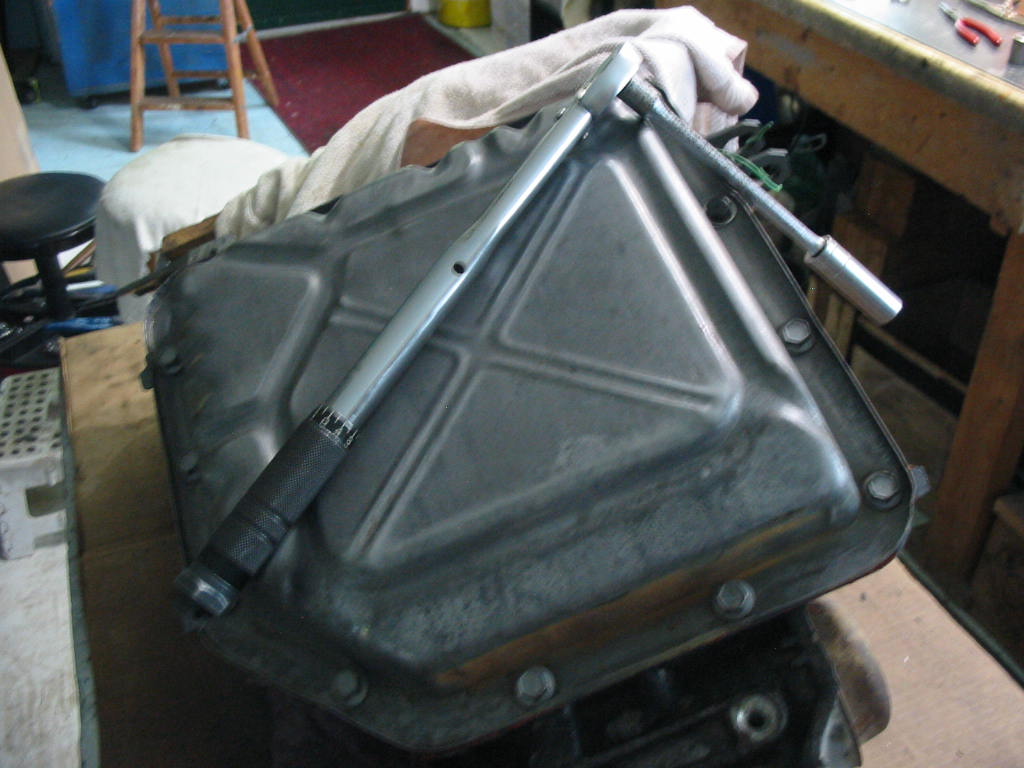
Back to the pan on the donor trans. I set the gasket in place with red gasket seal on each side – I used a small brush to apply the sealant. I then snugged the screws down. I waited a day and then torqued the screws to 150 inch Lbs per the manual.
Meanwhile a couple of parts arrived from Corvette Depot. Two new rear spindle nuts and a fitting that goes over the spindle threads. That will save the threads when I put the unit in a press to remove spindle from the spindle support.
3/4″ X 20 tap and die arrived. Cost a little over $20 from Amazon. I need these to clean up the rear spindles.
I cleaned up one spindle and the new nut spins on easily. Not so for the cap. I was a tight fit almost like a tapered plumbing fit. So I ran the tap through it and it then fit nicely on the spindle. It will protect the threads when I try to press out the bearings – much better than reversing the castle nut and threading it back on the spindle top. Supposedly you can hammer the spindle with this covering nut to drive it out of the bearings, but I prefer to press them out even if I damage the dust cover (flange plate) a bit.
Stopped by a local Chev dealer to get the positraction additive and some of their hypoid gear oil. They only had synthetic so I hope it doesn’t leak too much. Pricey stuff at $22 for the additive and $32 for a litre of hypoid gear oil. If this doesn’t clear up the chatter then I’m in deep do-do!
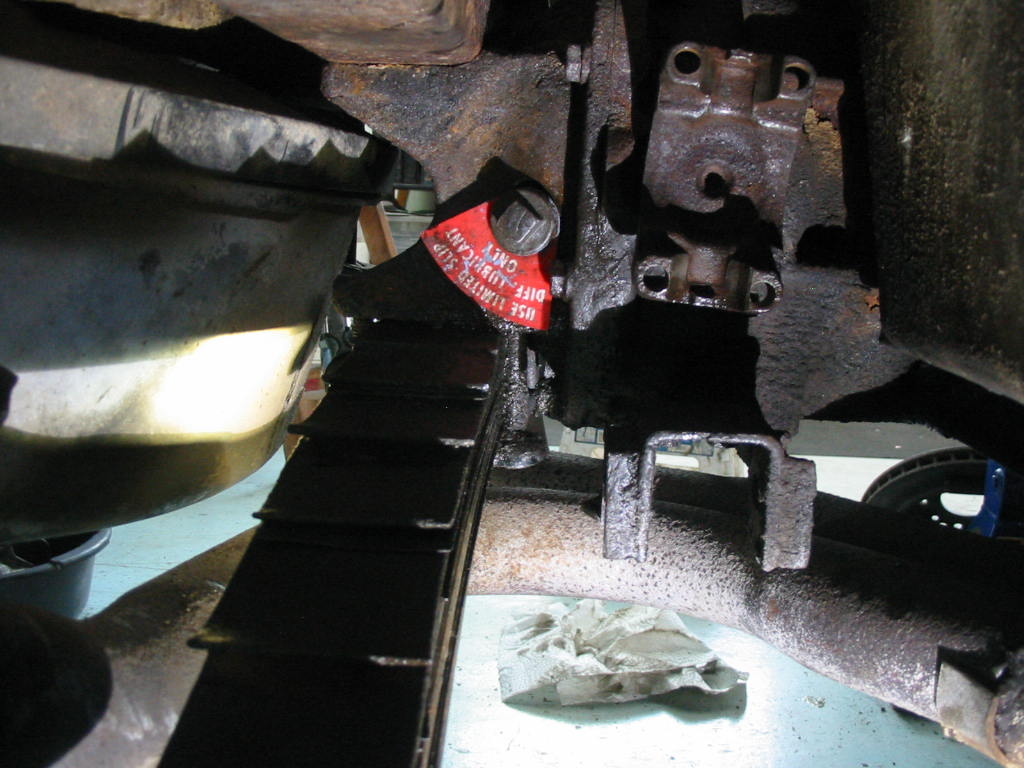
Oil changed in the differential. Much easier with the short shaft out of the way and the spindle assembly and caliper also removed. Still it takes quit a bit to suck out all the old oil with a vacuum pump. Quicker to get the new fluid and additive in using a squirt cap and small length of tubing on one of the litre bottles – in the photo above this one.
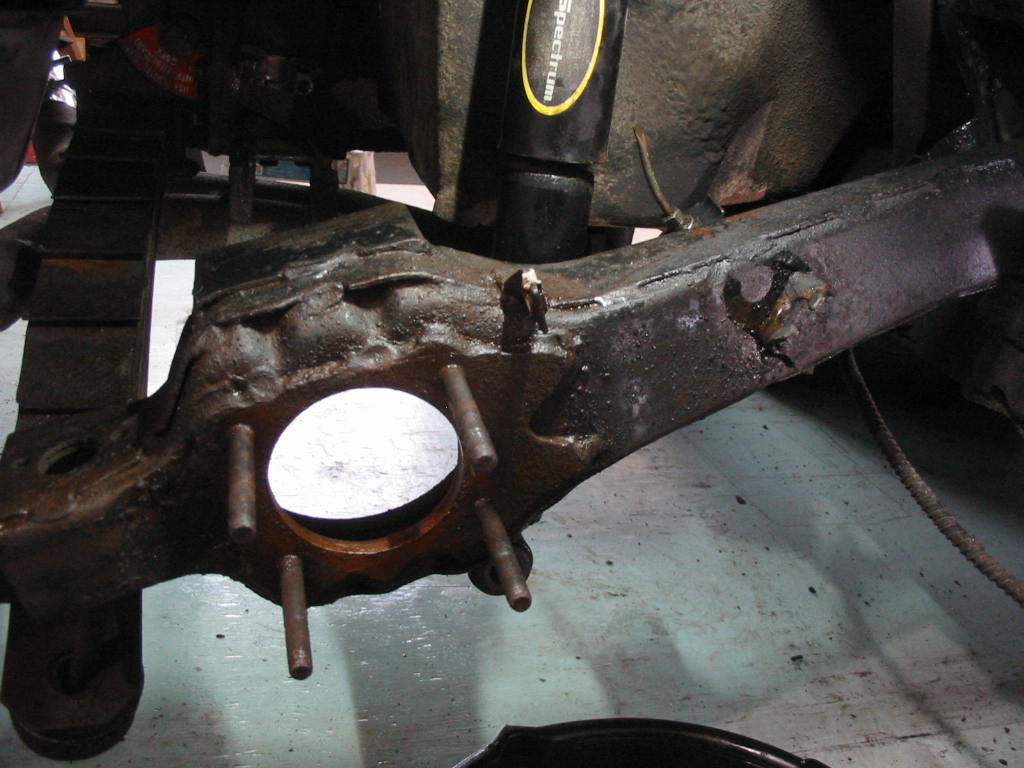
Time to clean up the trailing arms. really rough welding on the various metal sections. I managed to break off the clip holding the parking brake cable to the frame bracket on the forward side of the arm. The bracket was bent from some happening the car experienced in the past.
Sanded off the corrosion on the studs which should help with refitting the spindle assembly. I also ran a tap on the to straighten and clean the threads.
Once the trailing arms are cleaned up I’m going to replace the spring bushings with new polyurethane mounts. I would have preferred rubber, but it was all that was easily available . They shouldn’t make the ride any harsher as they might if I did the front end with them.
I broke the standard 3/8″ threaded rods trying to get the spindle out so I bought these extra strength rods plus grade 8 nuts.
One more go and I actually broke off the new rod. And that was with lots of heat on the spindle. There is no rust showing on the spindle or bearing so rusting in doesn’t seem to be the problem. Time to take the unit over to my buddy Don to see what can be done. It’s a difficult assembly to fit in a press, but we’ll just have to see what can be done.
New parts came in. The parking brake pads, a fuel vapour canister filter, bushings for the rear camber arms and bushings for the rear spring mount.
Drilling out the camber arm bushings. Removing the shock mount arm mounts from the bushings was a tough push – used my buddy Don’s large press.
New bushings for the camber arms. I’ll paint the arms then take them to my buddy to press them in.
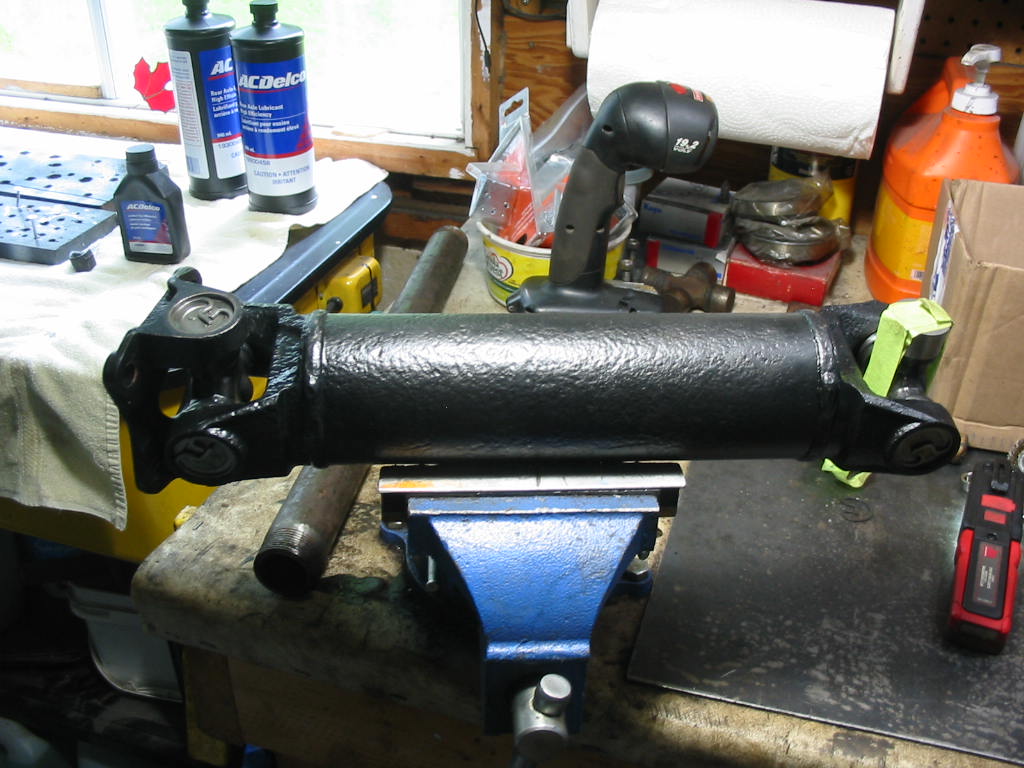
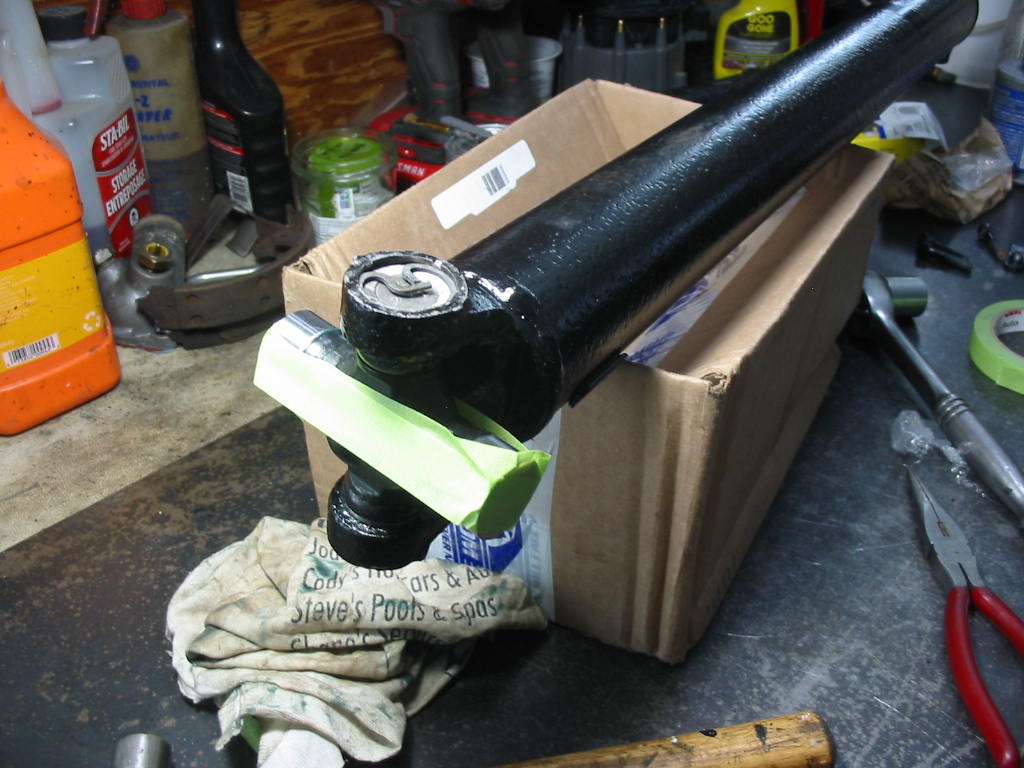
Meanwhile I have the drive shafts and yokes painted so time to put in the new universal joints. I’m using permanently lubed joints so no need for future greasing:-) The bench vice works best for me to get a nice flat and square squeeze to get the cups started into the driveshaft.
Once the cups are flush with the driveshaft yoke I used this tool to push the cups in just enough to get the clips in place.
One down and five more to go. That’s a bit of masking tape over the free cups to keep them in place until I get the shaft in place.
The object of this work was to swap out the engine and trans. I’ll get to that once I get the rear suspension, etc re-done. It’s taking a lot more that usual because the Corvette setup is so complicated compared to the usual rear end setup that isn’t independently sprung.
The manual says there is a way to take off the caliper and suspend it while working on the spindle, etc. I choose to take it off and out of the way. I”m using a old fitting with the pipe pinched off to keep the fluid from leaking out. I’ll have to bleed the brakes after, but I like to do that every two years at the least.
Lots of small parts to clean, sandblast and paint. I’m using Tremclad aluminum rust paint for all the small bits. Goes on easily and doesn’t need a primer base.
The parking brake pads on one side are fine, but this side is too far gone unfortunately. Rock auto sells Raybestos sets for about $35 cdn plus shipping.
Time to get the spindle out. I need to pull the assembly off the spindle and this is the setup that another C3 owner has used successfully. Those are3/8″ threaded rods and a thick steel plate. I tried earlier with a thinner 1/4″ steel plate, but the plate just bent and the spindle assembly didn’t move a bit. This time the plate held, but the threaded rods didn’t – even with heat applied to the spindle assembly in the bearing area. Next try will be with hardened threaded rods.
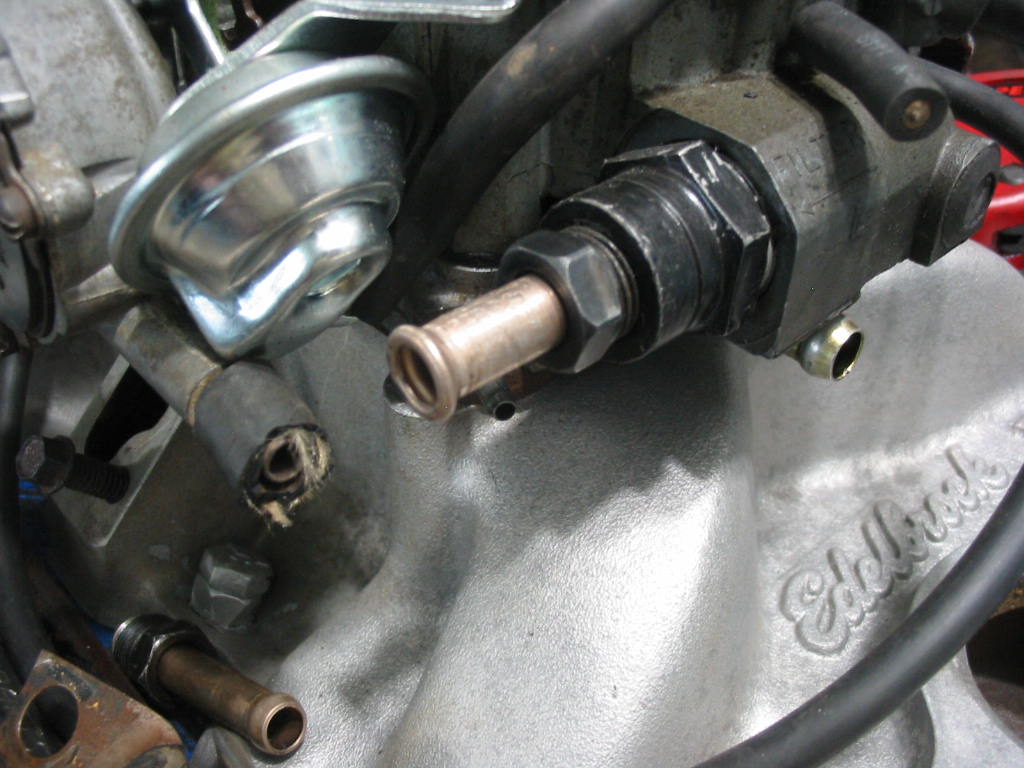
Meanwhile my fuel filter and pipe bender came in. I managed to get a line bent and the filter in place – no clamps yet. I will be adding a bracket from the front right intake manifold bolt to the fuel line for added rigidity. The line is 3/8″ nickle copper. I bought a length of brake line rather than spring for a roll as it’s quite expensive. Bends well, but even with a proper pipe bender it is easy to kink the pipe. I got a couple of kinks in the line, but nothing serious.
My double flare tool does a nice job of putting a bubble on the end of the line for better sealing. I just do the first flaring step and then just a bit of the second. Here I went just a bit too far in the second step. It still gives a nice sealing ring. It’s just not as nice as the one in the bottom left.
Some difficulty getting the right short shaft out, but it finally came off. This happened on one of the clips holding the universal in place. Nothing to grip on the ends of the broken clip and I don’t have a tool to grip the thin edge. I have pushed the universal away from the clip and then using a small nail punch I got the remaining part of the clip to slide around in the groove. I then was able to get a small screwdriver blade to just slip over the clip and pry it out enough to drop out of the groove. Once that happened I was able to tease the rest out.
Lots of shiny parts ready for the engine install.
I had a small wire cleaning brush in my stash. I cut the end loop off and then used a drill to give the trans yoke mounting hold a good cleaning. I also used it on all of the differential yokes and got all the old corrosion out.
The trans yoke was a bit rough where the seal fits so I used some 1500 grit paper and a sports lace to clean it up and then I polished it with emery cloth.
Hard to get a clear shot of a shiny part. The seal surface is much nicer, but there is a small section that is a bit rough. I leave it as is for this install and expect a bit of leakage. I may repair the yoke with a sleeve for the next install if it does actually leak.
Time to get the short spindle bearings removed. Lots of crud to clean out.
Some of the brake, parking brake parts and camber adjustment bolt. Cleaned, sandblasted and painted with a coat of aluminum rust paint. Should keep them nice for quite awhile.