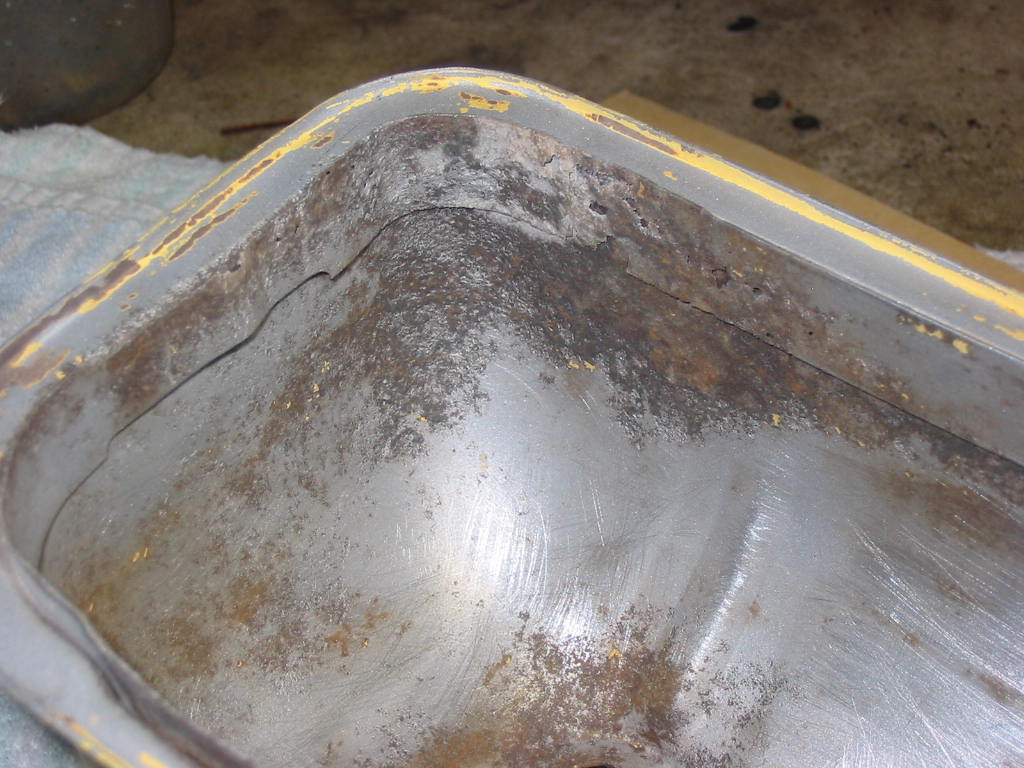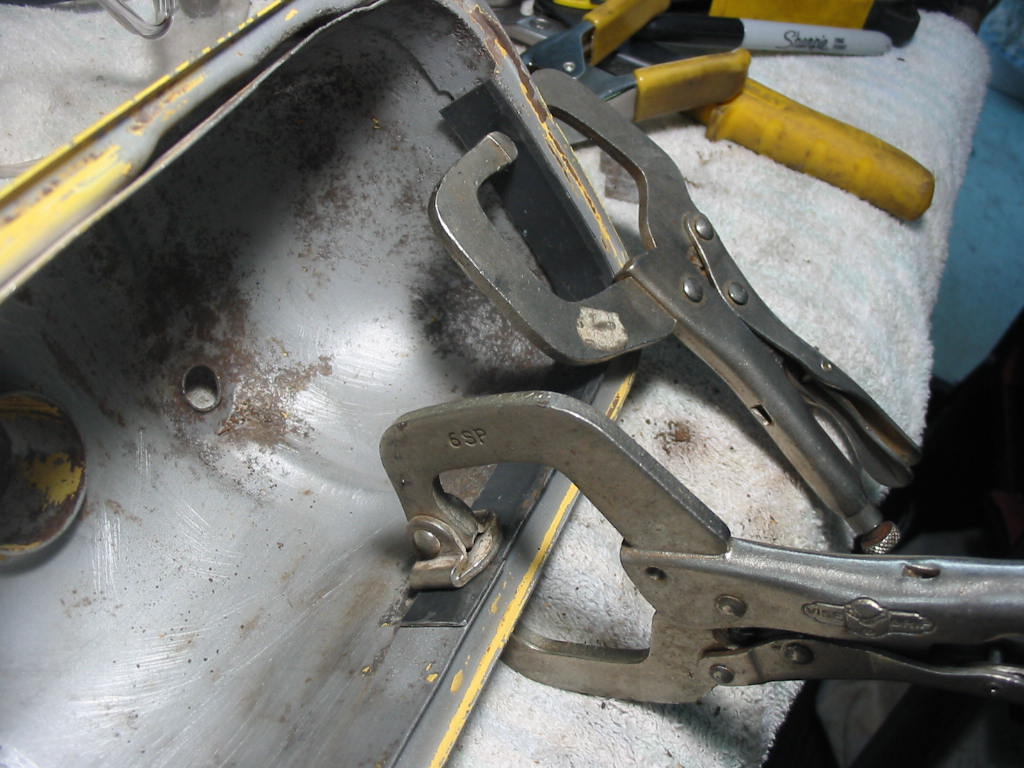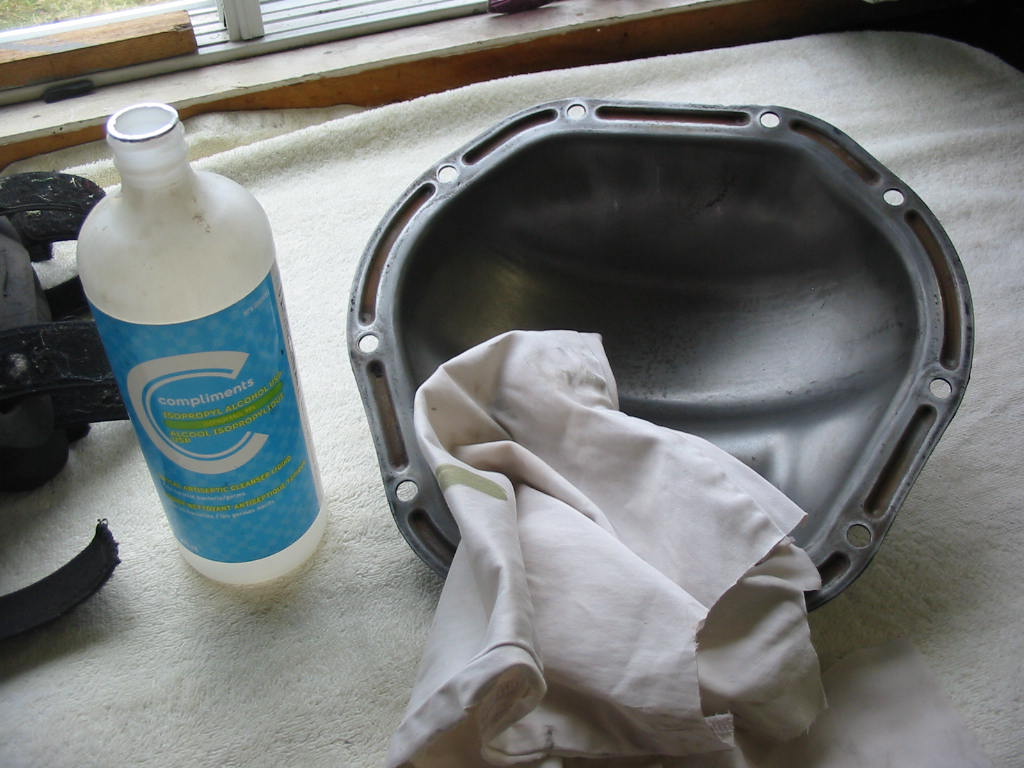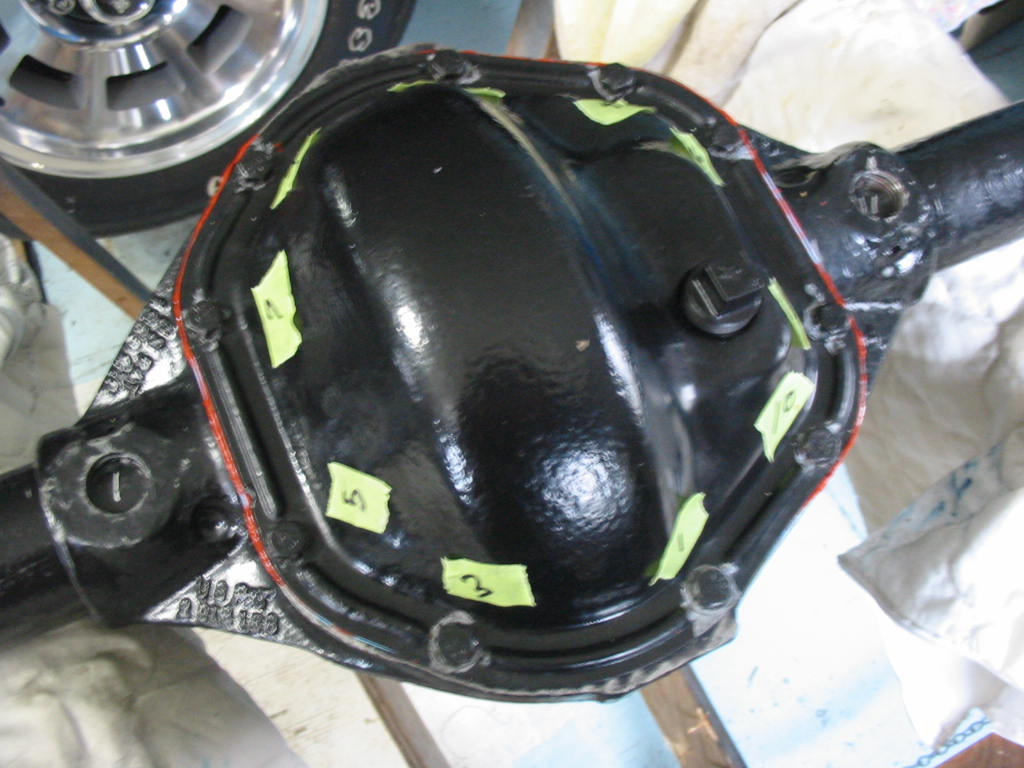
In order to get at the back of the pan I had to remove the flexplate – not a biggie.
I’m using small balls of dum-dum to fill the bolt holes to keep paint out of the threads.
All primed up using Tremclad rust primer and regular Duplicolor automotive primer. I’ll need to add another full coat of Duplicolor primer – see problems below.
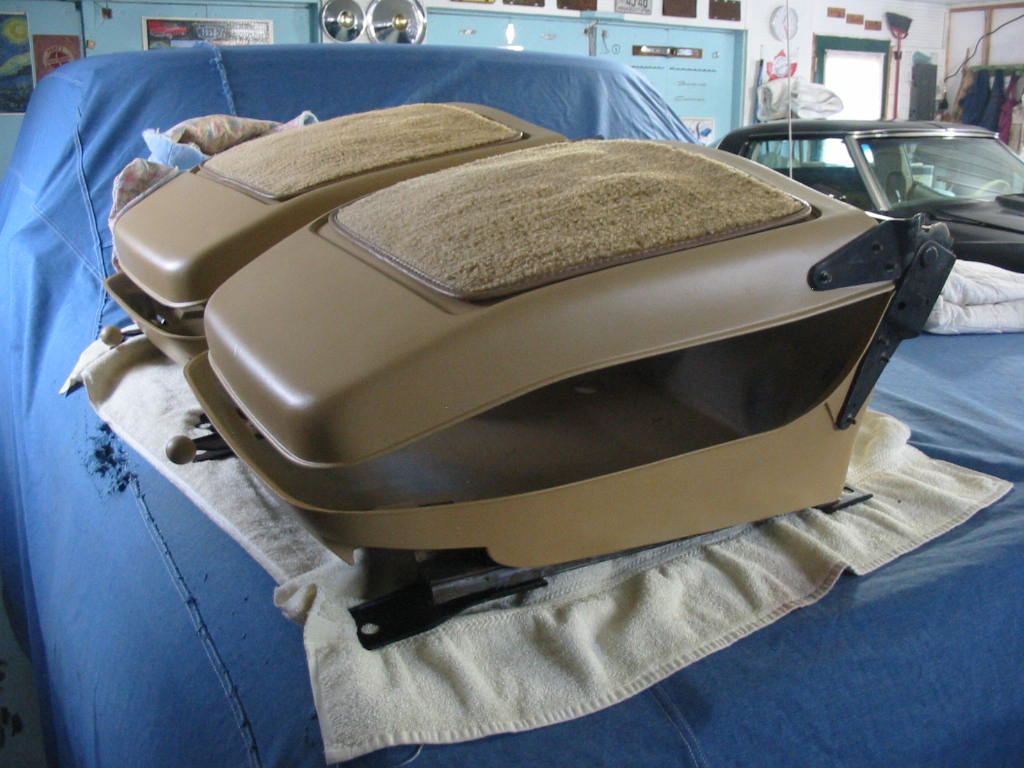
I went on to paint the seat bodies and hinge covers with doeskin spray paint I ordered in from Corvette Depot. The hinges came out fine, but when I put the paint to the seat bodies it dissolved the primer and wrinkled. It seems the Tremclad primer is not compatible with this vinyl paint. So it’s back to sanding and prepping again. I tested a patch on the inside of the body with regular Duplicolor paint and then the vinyl paint. It works fine. So I’ll have to re-prime the seats with regular automotive primer.
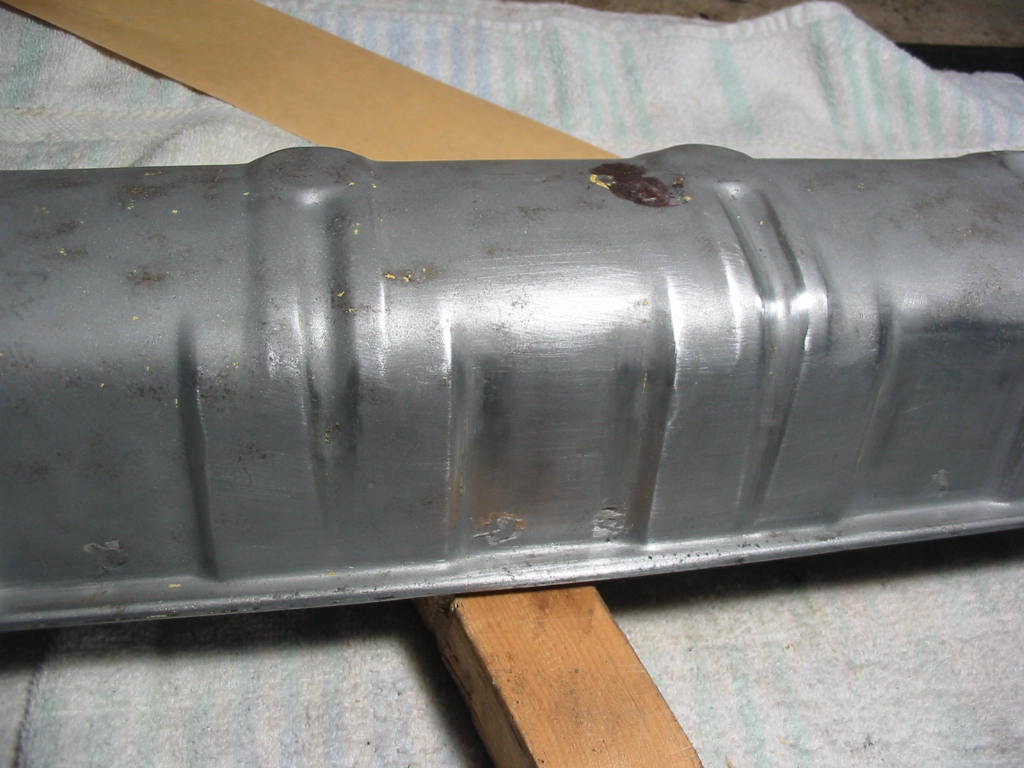
A little spare time so I went on to clean up the exhaust manifolds – they got a good coating of oil when I adjusted the valves and didn’t put the oil clips on the rocker arms! I’m also cleaning up the exhaust pipes and will paint them with VHT high temp black engine paint. For the price of the duals ($500) you’d think they’d be stainless. They’ll rust up very quickly unless I get some paint on them. All the band clamps and regular clamps are stainless.
The seal went in place fairly easily. I used a couple of pieces of plywood under the upper sides so that I wouldn’t be hammering on a canted cover. I bought a set of seal insert tools, but for some dumb reason I ordered metric. I’m a bit stubborn and am using them anyway – I just turn them over. Not the best, but so far so good…
Plenty of cam startup lubricant on the chain and sprockets before installing the cover.
A messy coat of Permatex aircraft gasket compound before doing the install. The engine will likely leak some so I’m trying to keep it to a minimum.
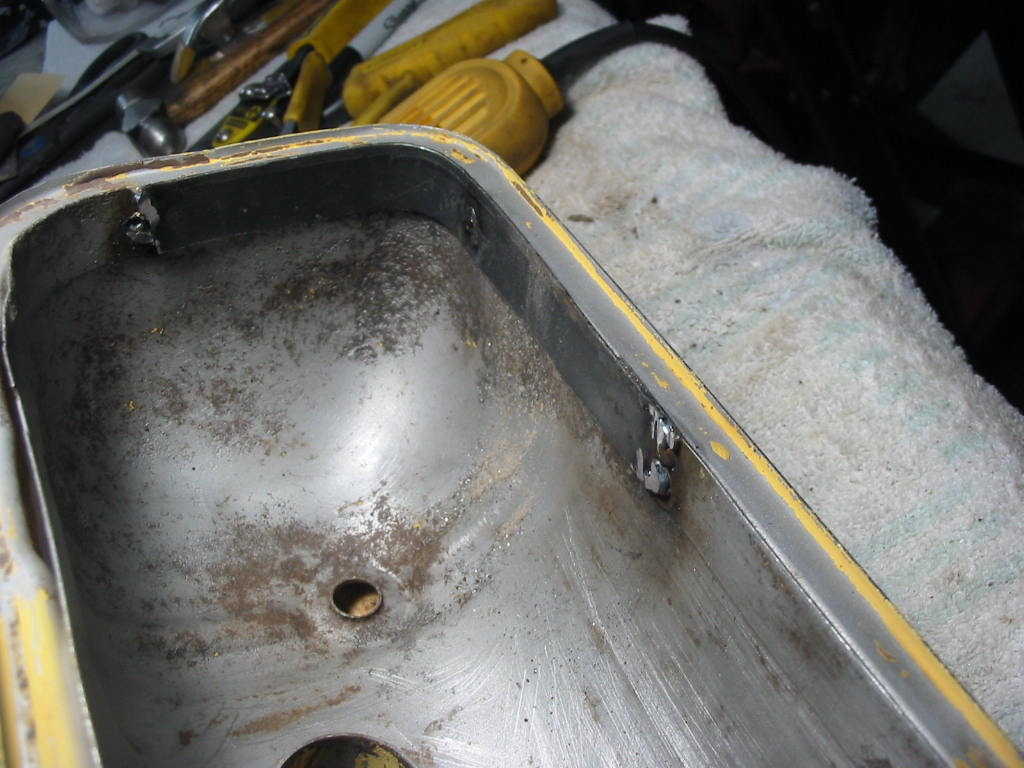
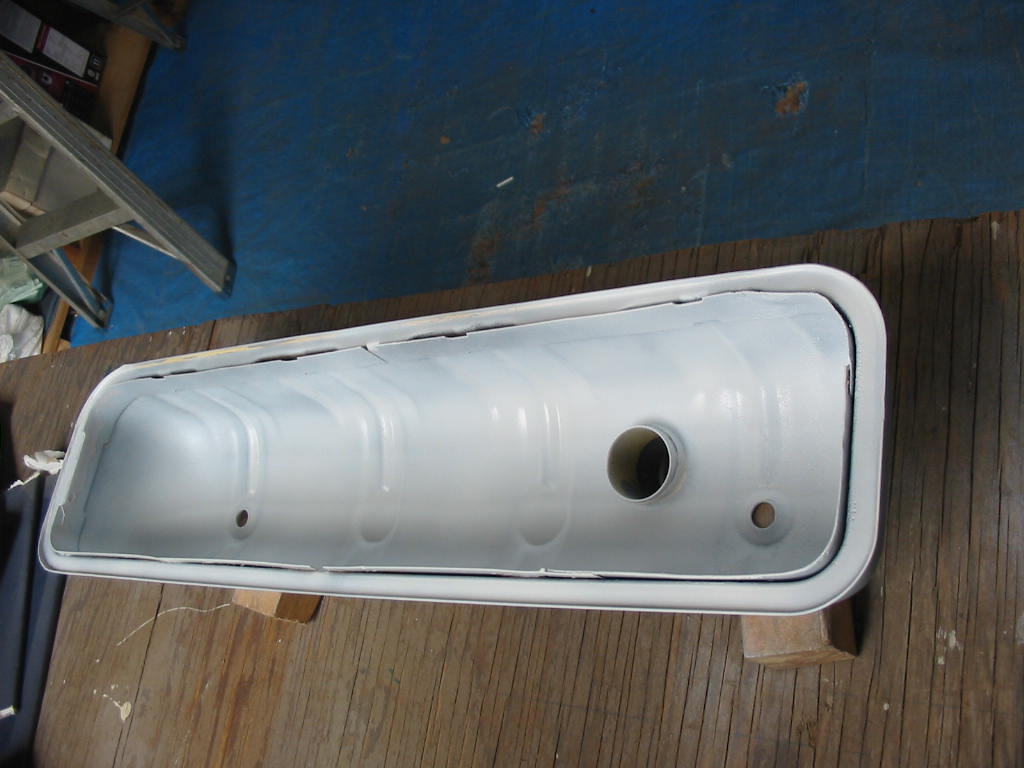
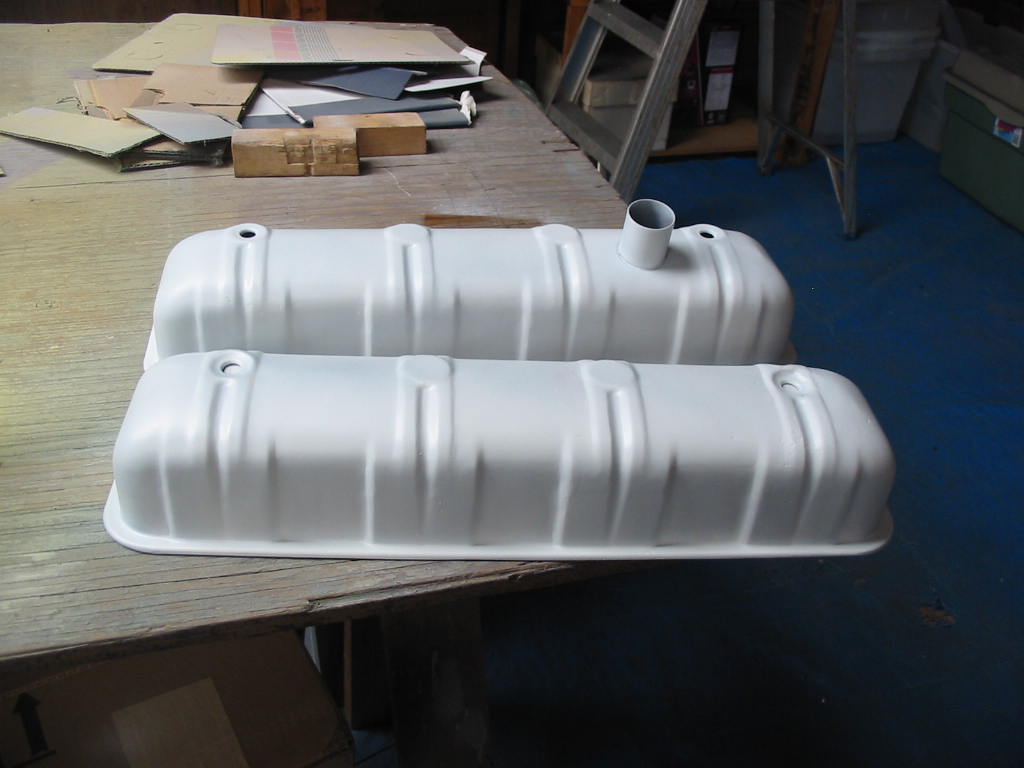
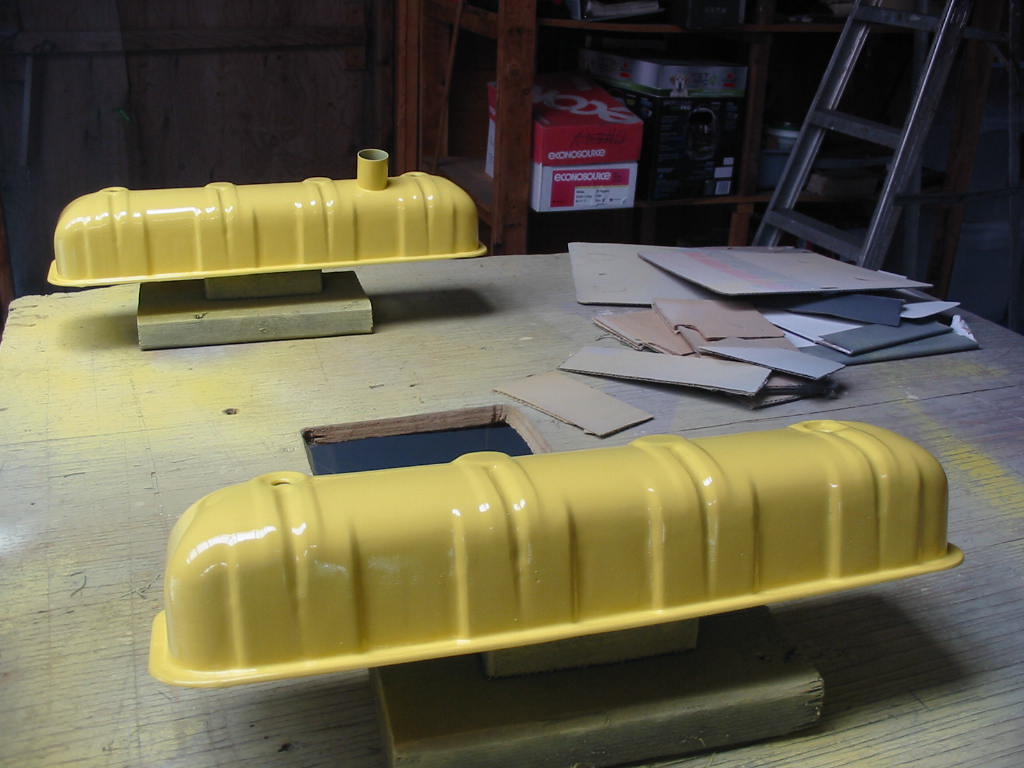
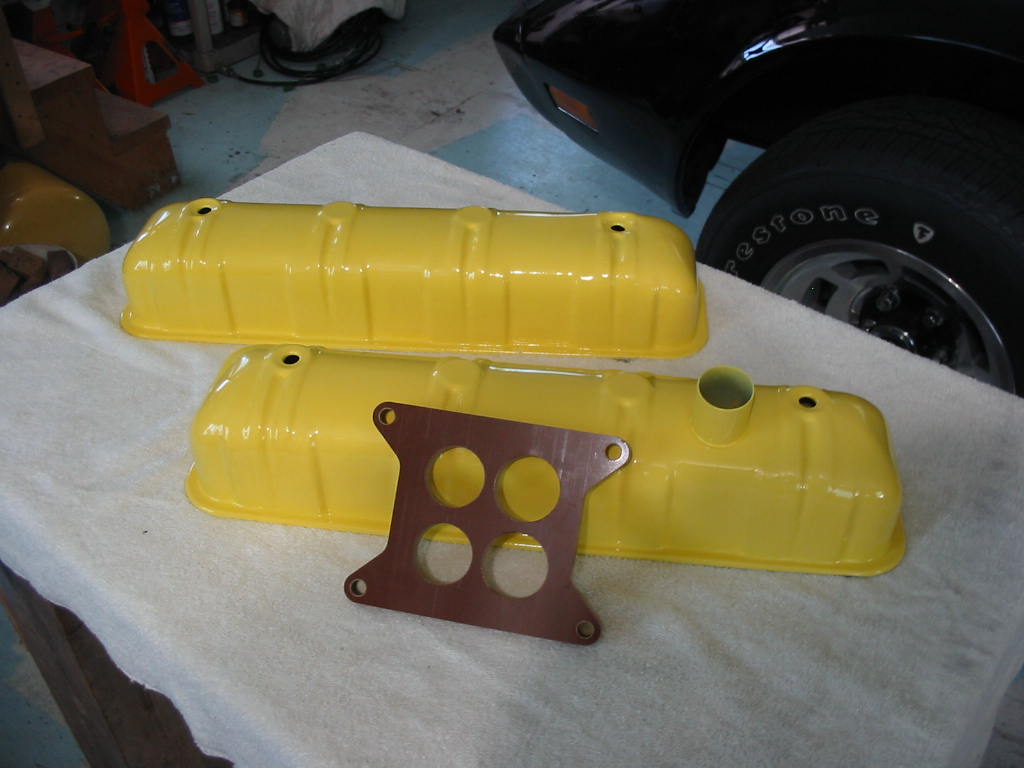
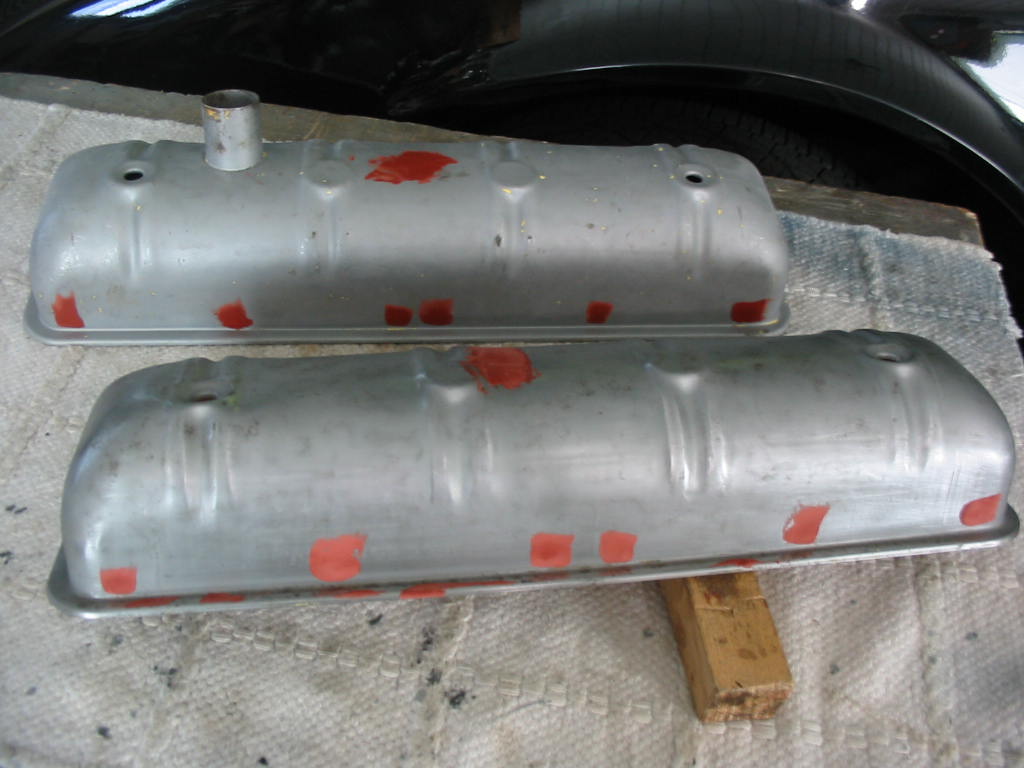
In place and torqued to 80 “#. I’ve put an old set of valve covers on until I get the engine painted.
Before I put the pan in place I needed to do a distributor shaft check and set it to TDC
I bought a new distributor middle shaft with a metal collar. The seller recommended that the spacing be checked to be sure that there was play in the shaft when the dist. was in place. I found that I had about 1\4″ of play so no fear of binding there.
Next I located the engine’s TDC and then fiddled the oil pump shaft slot until I could get the rotor to point roughly in this location. That gives enough room for the dist. to be turned without the vacuum advance body to hit the intake.
I marked the intake where the rotor was pointing (X on left) and then slowly pulled the dist and marked the intake where it stopped turning to the left. I should be able to get it back in the right spot later. I will need to note the location of the oil pump shaft slot. I will be priming the engine with the oil pump before initial start up which will change the location of the oil pump shaft slot. I need to get it back to the right spot so the dist will slip in as it drops in place.
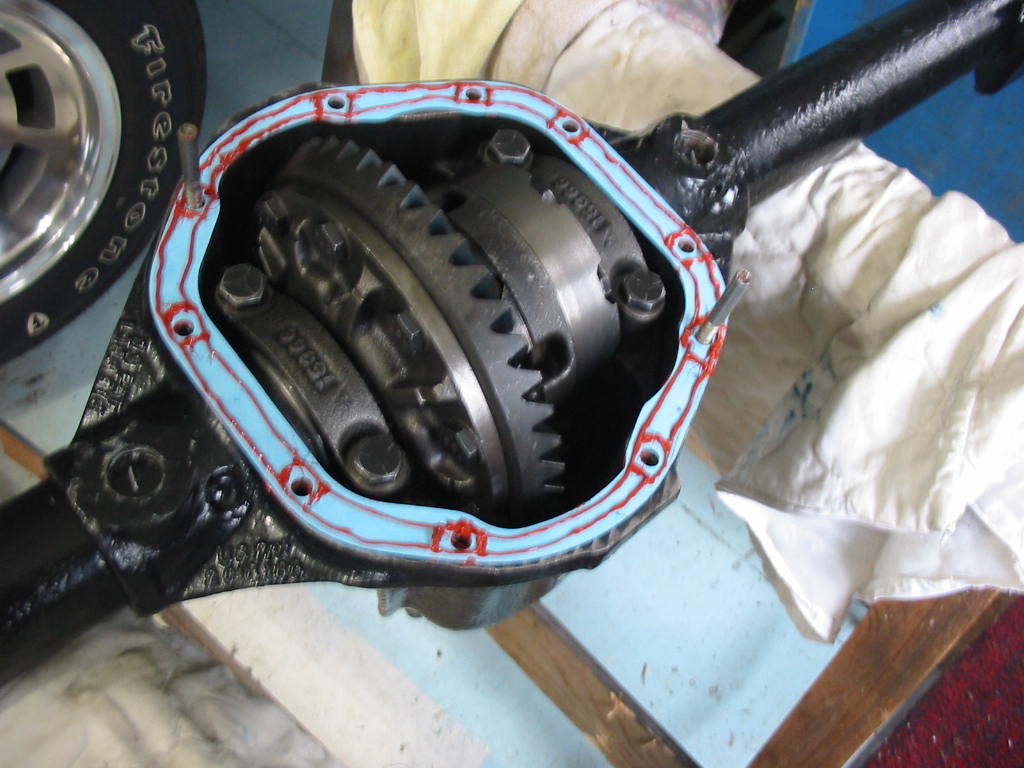
Time to put the pan on. Poor photo. Just trying to show the two alignment pins. There are two others on the other side. With all the gaskets in place I’m able to set the pan in place without the gaskets and pan moving around.
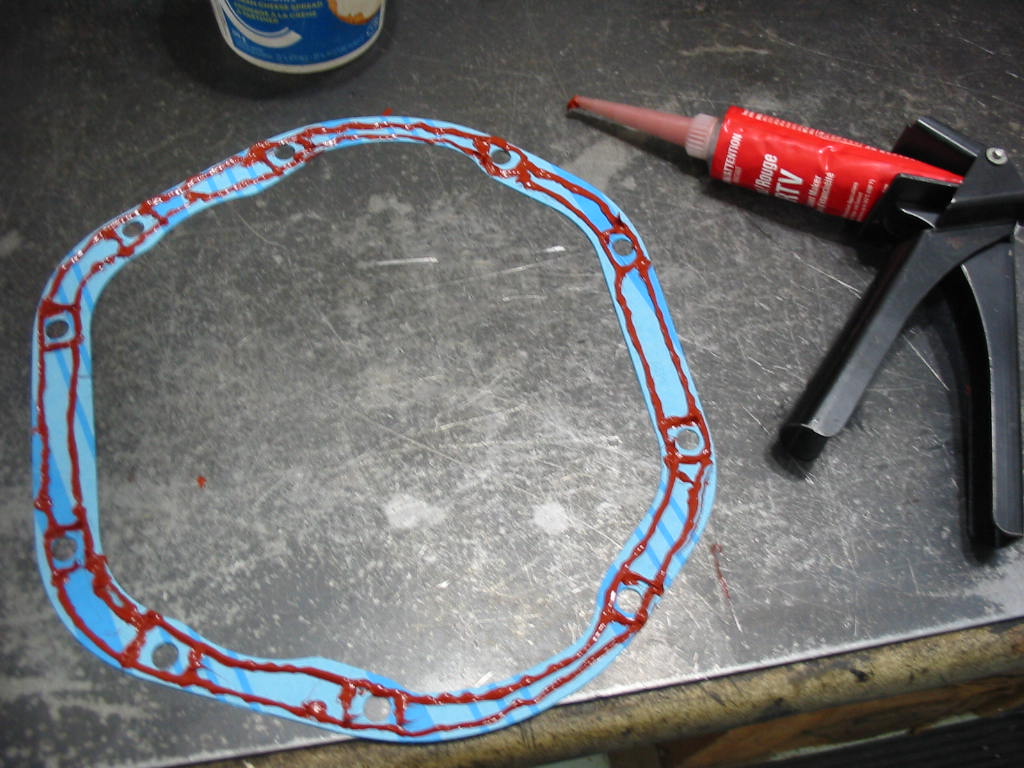
I missed taking a shot of the pan gaskets getting a coat of Permatex gasket sealant. I usually use red gasket sealant on the ends of the rear main and front pan gaskets. This time I’m trying the Permatex product.
I’ve made dummy gaskets for the fuel pump and the water pump openings so I don’t have to scrape paint off later.
Final block cleaning before priming and paint. Still need to tape off the exhausts, intake, etc.
I’ve given the new Fel-Pro beaded steel gaskets a coat of Permatex thread and gasket sealant.
Heads back on and bolts torqued to 65’# in the circular sequence recommended in the service manual.
Putting in the new lifters with lots of start-up lubrication supplied by the cam maker – Mahle.
I’m putting the push rods back in their original locations and I’ll also do the same with the rockers. At least the rocker-pushrod contact will not need to re-seat. The rocker/valve and pushrod/lifter will still need to re-seat themselves.
Rockers in place and tightened to the basic one turn from zero lash.
Cleaning the old red sealant from the intake and going over the gasket surface with scotch bright type pad.
I’ve modified the restrictor plates to completely block off exhaust gases from under the carb. Today’s fuels boil easily enough without the extra heat. I cut small rectangles of thin tin to sandwich between the two sides of the restrictor plates.
I used some red sealant on the ends of the front and rear gaskets and some around the water ports – on both sides of the gaskets. I tightened the manifold bolts just snug. I’ll torque them down to spec after letting the red sealant set for a day.
Next I’ll get the timing cover and pan in place before prepping the block for painting.
More stuff from Corvette Depot although they actually originated from Corvette Central in the US. All the parts needed to install them from the exhaust manifolds to the mufflers were included: exhaust manifold brackets, inserts and donuts and two muffler clamps. I prefer band clamps so I’ll need to order a couple of those and also find an adapter to join the 2″ tail pipe to the 2.5″ ID mufflers.
These two gas lines are just in front of the rear wheel. I don’t think they were from the factory. The metal lines must have been damaged and so were replaced. I’ll refit them with ethanol proof lines.
Lines replaced with nice new piping. Hopefully the rest of the lines are in good shape. I only see signs of light surface corrosion and the lines along the frame are nicely coated with some sort of undercoating. I’ve got a new fuel pump to carb line and the special S formed 3/8″ fuel line to feed the carb on order from Corvette Depot.
I just got a notice from Corvette Depot that they have shipped my new 2″ dual exhaust pipes. So time to get the old system off. First to remove is the two Walker quiet tone mufflers. I installed them with band clamps and lots of never-seize aluminum. They came off nice and easy.
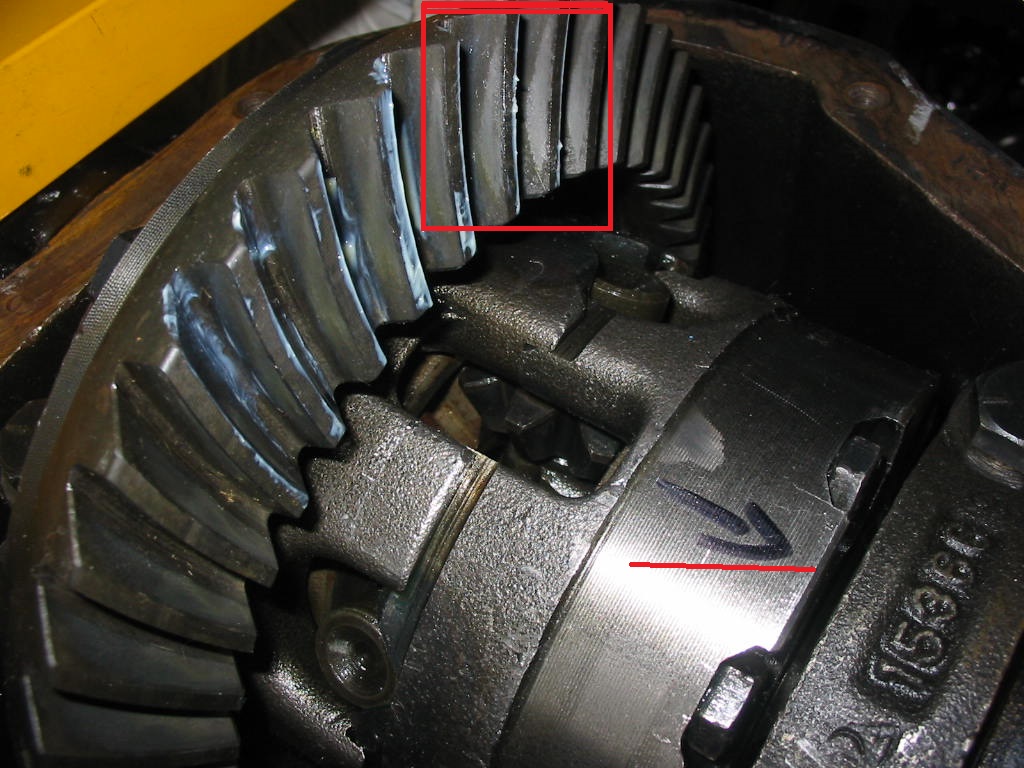
I had to use my hand grinder with a zip cut wheel to get the pipes off. There was an inch wide hole at the junction point (red square). The pipes are a mess of sloppy welds and rust-throughs in a couple of other spots. The exhaust pipes are 2″ off the engine into 2.5″ leading to the mufflers. I will need to use a couple of 2″ to 2.5″ adapters to fit the new system into the mufflers. I figure that the increase in exhaust size is about 22%. over the single/split pipe system.
Just got notice that my cans of doeskin vinyl paint have shipped from Corvette Depot. Time to get the seats and hinge covers ready.
One seat primed and I’ll get the other done today.
The original felt padding on the two upper side panels just behind the seats has deteriorated beyond use. I picked up some nice soft sponge weather stripping (one side sticky) that fits nicely and seems to work fine.
Upper side panels in place and T-tops finished and installed. Time to get at the fuel lines.
The rubber boot around the gas cap is old, hard and dry. It split getting it out so that’ll have to be ordered.
Some minor surface rust. Not too bad overall. the ground connection might be a problem. The two rubber gas line extensions leading to the tank filler connection are what I want to replace with ethanol proof hose. Super tight spot to work in.
I managed to get the short pipes off the tank connectors, but there was no way to get at the inner clips, remove the pipes or hope to get new pipes in place. I did find that if I reached up behind the tank from under the car I could pull the two pipes over just enough to get access.
I measured two short lengths of 1/4″ and 3/8″ ethanol proof pipe and slid them over the exposed pipes and installed the clips. I would have been easier to use gear clamps as there is little room to get pliers in to squeeze the clips. The pipes are actually bent to the rear and I had to over bend them forward to get them to line up with the tank connections.
In the end the ground was so rusted that it broke off. Not a problem. I removed a bolt from the tank filler housing, sand blasted it and connected to it with a new U electrical connector on the bolt. The bolt’s fixed washer needed to fit flush with the housing so I slipped the connector between the bolt head and the washer.
New pipes clipped in place. The emissions system pipe on the left also needed to be replaced. I managed that with a set of curved long nose pliers through the gas filler opening.
An order in from Summit Racing. A Fel-Pro steel beaded gasket (.015 compressed), a few bottles of Lucas Zddp and four AC Delco oil filters.
To be sure of the gasket fit I matched it up to the new gasket – here the old one is on the bottom. All the holes matched up as they should. Soon time to get back to the motor and get the top end back on the block.
Next: Finishing the gas line work and on to the exhaust
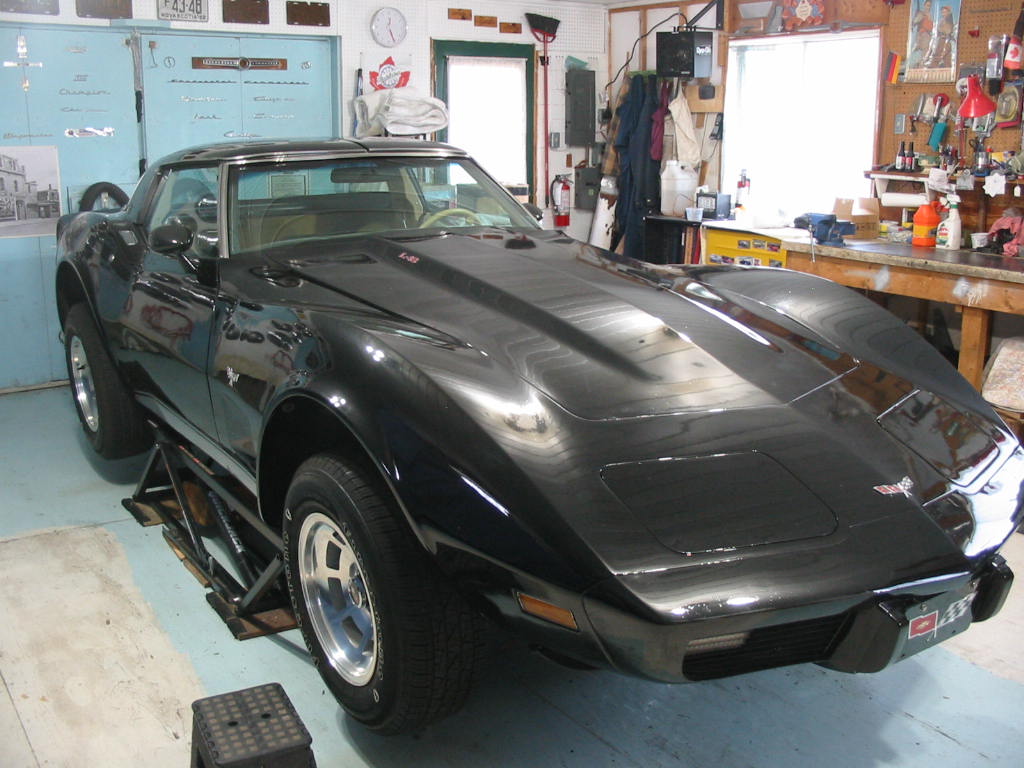
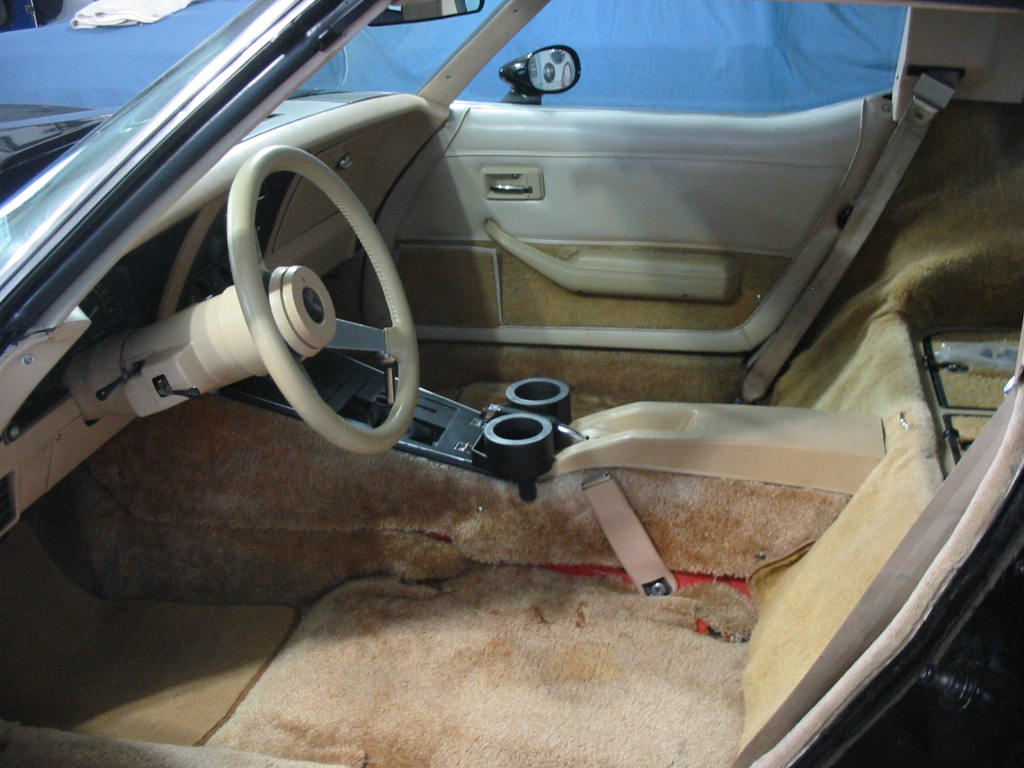
Rear carpet and package tray installed. the speaker boards were a bit of a pain to install. Not the best design. This interior work was supposed to be my winter project but my engine work got in the way. I was going to swap the Studebaker rear end for a posi, but that’ll have to wait now. I want to get the Chevy on the road in the spring and also I’ll need some time to get the bugs out of the new engine/trans.
I tried to install the carpet with just the sound deadener in place, but it would lay correctly. so I cleaned up the old foam and added some new where the old was too ratty, for complete coverage. The original car must have had the thick felt covering on the floors as is usual for that period.
Carpet back in place with door sill and console side panel in place. Fits OK now with the thicker padding underneath. Now to move on to the drivers side.
All ready for the seats. I have yet to paint the seat shells – doeskin paint coming from Corvette Depot – and the upholsterer still has the seat pads.
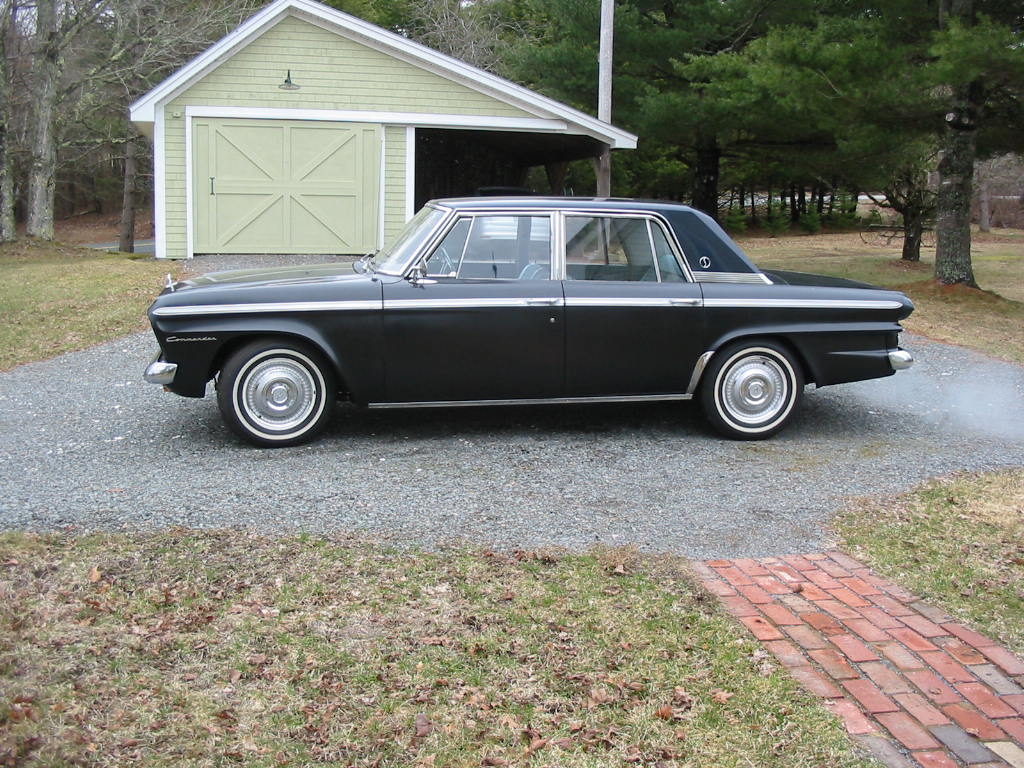
Work needed on the t-top inner panels. they are coming loose. in spots.
Some of the Velcro attaching mounts are loose and some came off when the panel was removed. Why GM used paper composite materials for these panels I’ll never know. Plastic would have been so much better – even fibreglass! Replacements are available here in Canada for about $350 each plus shipping. I’ll try to save the ones I have and have the $700+ for other goodies like headers:-)
I’m using Gorilla two part epoxy glue and it seems to be working OK.
Clamps to hold the Velcro mounts in place. The clamps ended up leaving an impression in the vinyl. If I need to do it again I’ll put some thick cloth under the clamps.
The panels snap back it place with just a firm push over the Velco clips. Only in a couple of places did I need to use a bit more force.
Next: a bit more interior and then on to the gas lines.
I sharpened the pointer – a piece of coat hanger attached to one of the timing cover holes in the block.
I’ve degreed cams before and it was a simple process of finding true TDC and then using the input degrees listed for the cam to do the check.
Now the manufacturer’s don’t indicate the number of degrees for the intake at .050 of lift. I tried finding it on the Melling website and elsewhere on the internet, but no real luck. What is indicated is the Lobe CTR: Int 107 and Exh 117.
I have been using this publication for bits of information to supplement the GM service manual. In it they discuss degreeing the cam. They print that there are a number of ways to degree a cam. The method they describe in the pub is the “Lobe Centre Line” method. It uses the manufacture’s specs for the Lobe Ctr. I’ll be using that to check the intake (107 degrees). My crank sprocket will allow me to retard or advance the cam by 2 degrees if necessary. I also had to watch a couple of utube videos to get comfortable with the process of LCL cam setting.
Before starting the job I decided to install the flexplate/ring gear. It will allow me to move the crank small amounts when finding TDC and the cam lobe centre line. I’m using new shake proof washers to install the plate along with a bit of blue Loctite – I’m more of a belt and braces man if you get my drift.
I’m back to using my aluminum strap for measuring piston deck height. In this shot I took the opportunity to check for true TDC (that is TDC for the piston not the crank and piston) I used that to once again check the deck height. Again using feeler gauges, I found that the deck height is actually smaller than first measured. The new measurement is .042 and using that the compression ratio rose to 8.78:1 with a quench of .057. A passable ratio and a bit better on the quench side. I’m happier with that.
This is a half-inch nut that I used as a stop for the piston. I set the degee wheel at TDC with the piston roughly in that spot using the dial gauge. I then rotated the piston back about 2 inches and then forward with the nut in place. I noted the degrees on the degree wheel when the piston contacted the nut. I then removed the nut and move the piston over TDC about 2″ and then back with the nut in place and took another measurement. The spot between the two measurements was the true TDC. I moved the crank until that spot was at the pointer and then I turned the degree wheel so that the pointer was at TDC.
This was my setup to find the #1 intake lobe centreline. I couldn’t use a pushrod since my dial gauge doesn’t have a long enough arm. So I used a short length of tube which allowed my gauge to be more or less directly above the lifter. Again set the gauge roughly at the lobe top and then I marked the degree wheel at 20 degrees on either side of the intake lobe – being careful to do the measurements with the engine going in a clockwise direction to keep the timing chain taut.
I chose to use 20 degrees rather than 50 just in case my cam’s lobes were not symmetrical – that was a recommendation made in one of the Utubes I watched.
Lots of marks on the wheel from a number of tries. The ones that count are where the degree wheel pointer sits at about 45 and the bar under 80. Those were the marks 20 degrees on either side of the cam centreline. Half way between is the cam centre line which sits at about 73. The degrees from the top dead centre mark and that point are roughly 107 degrees. That is the correct location for the cam according to Melling’s specifications (see photo up a bit). That was with the crank sprocket in the centre slot so no need to advance or retard the cam. Good as it is – hooray!
While I wait for the steel beaded Fel-Pro head gaskets and other stuff from Summit racing I’m going back to the interior to replace the cleaned carpeting.
A little rig I made up to check the piston to deck clearance. Not exact, but close enough. I got a measurement of .047. With a beaded steel gasket with a compressed thickness of .015 I’m looking at a quench of .062. Not a good number for a performance engine. The original engine had a deck height of .042 and a compressed head gasket of .015 so a quench of .057, but that was with dished pistons and I’m using flat top pistons. If GM was happy with that then I should be OK.
I don’t have the special tool to push the oil pickup tube into the oil pump. I used a brass punch, small maul and lots of oil. Worked OK I twisted the pick up down a bit.
I installed a new oil pump extension rod with a metal collar before installing the new standard oil pump.
I installed the oil pump and then put the pan in place to check and see if I had twisted the pickup down too much. Turns out I did and it held the pan up off the block. I just twisted the pickup up a bit and the pan fit properly.
Time for the cam’s timing chain to be installed. I’m using the harmonic balancer installation tool with a metal spacer to push the sprocket on to the crank.
This is a Cloyes timing chain kit. The crank sprocket can be installed in three different locations for 2 deg advance, factory fit and 2 deg retard. I have put it on the factory fit for the first test of the cam timing.
Timing marks lined up. As you can see it is a double roller setup. I think I went overboard on this as the engine won’t be raced or driven extra hard. A standard quality single roller would have been fine.
First step in degreeing the cam is to install a degree wheel and static pointer.
First step is to measure the new piston clearance. They are tight on .002 so I’m thinking maybe .0015 or maybe .001. Good to go as they say.
I used the piston to push each of the two top rings in the bore to check the ring spacing. They are in the range according to the instructions with the rings – Minimum of .016, actual .020 (which is below the .027 max in the service manual)
Rings on the piston. I used my fingers to get the oil rings in place and a set of piston ring expanders to help get the first two on. I’ve rotated them according to the manual – top ring at the top, second at the bottom, oil expander at the top and the oil scrapers at 4 and 8 o’clock.
I’m coating the rings and the cylinder wall will some fresh engine oil before putting the piston in the ring compressor. I have short bits of rubber hose over the rod studs to protect the crank when the piston is pushed home.
I’ve tightened the compressor then pushed the piston out until the skirts are just showing. That helps position the piston before tapping it into the bore.
Number 1 and 2 pistons in place with a bit of plastigage on each. I’ve squeezed in a feeler gauge between the rods to stop distortion when I torqued the cap nuts. The clearance was about .016 which is a bit higher than the service manual, but less than the .025 limit other 350 references indicate.
Plastigage showing about .0015 which is way below the service manual list of .0013 to .0035.
A liberal amount of assembly lube before putting the caps back on and giving them a final torquing to 45#’
On to balancing the pistons. Unfortunately I wasn’t able to balance the pistons and rods separately. I had to send them out for the rods to be removed from the original pistons and the the new pistons ‘hung’ on the rods. I didn’t want to mess with them and ruin a piston in the process.
I did weight all the pistons before they went to R&D to be hung on the original rods. This won’t be a professional balance by any means, but at least the pistons will be about the same weight and the piston/rod weight will be also about the same. I’ve sealed off the wrist pins as best I can to prevent any fine filings from lodging between the piston and its pin.
The recommended p rocedure is to remove metal from the pin bosses. With the pins in place I didn’t want to grind near them so I removed what I needed from the outside bottom surface and any adjoining casting ridges.
Once the piston difference was evened out I removed the remaining weight from the total piston/rod combination from the metal blob on the end rod cap. For example if the total weight was 1309 grams which was 7 grams heavier than the lightest piston/rod weight and the piston was 3 grams heavier than the lightest piston I first removed the 3 grams from the piston and then took the remaining 4 grams from the the rod cap.
After a couple of hours I had them all done. They all are now about 1302 grams each. My scale only goes to rounded grams. I could have done better with a scale that showed a couple of decimals. Even so this should help the engine run smoother.