Yet more door work!

The inside nut on one of the regulator supports was missing. I used my wire mig welder to attached a new nut. That way I won’t have to hold a nut on the inside – which is almost impossible due to it’s location.

Right side tracks all cleaned up and ready to go. I have applied a light coating of white grease to the track and a coating of chain lube to the roller. I will also apply chain lube to the rollers on the regulator and on the regulator gear and electric motor drive wheel. It sticks well and will stay in place, I’m sure, for as long as I have the car.

The regulator is normally riveted to the inner door panel at the factory. It has been worked in the past and was secured by a couple of nuts and bolts. I decided to fasten a couple of nuts to the inside as they are also difficult to get at from the inside.

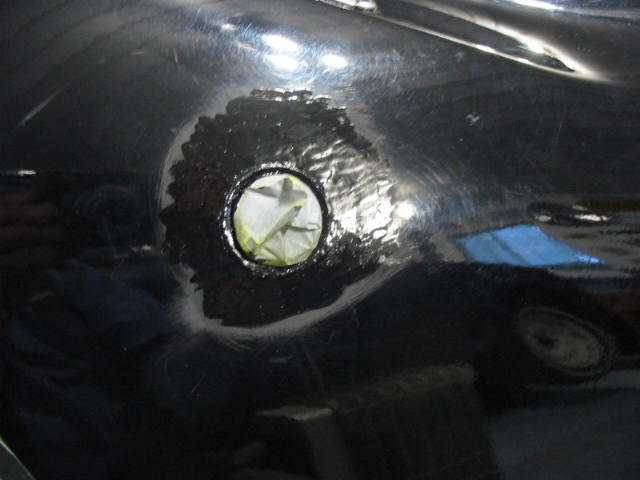
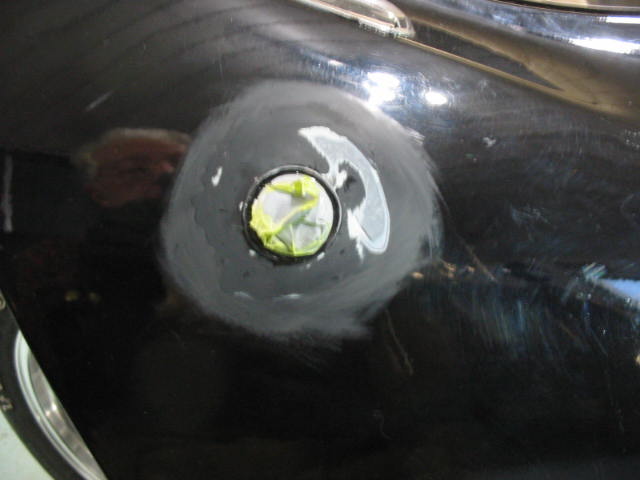
When I removed the door lock I found this mess. The fibreglass was broken off or cracked around the hole. I touched it up with some fibreglass resin to stiffen things up.

I cut out a new plastic gasket for the door lock that is about 1/8″ larger than the normal one. The idea being it would provide a better support for the weakened fibreglass. A coat of primer and some gloss black seems to be holding nicely.

With a little bit of effort I was able to get the lock in place and solid enough to be fully serviceable. When it comes time for a repaint the hole needs to be filled in and a new lock opening cut out. Meanwhile, it works. I’ll touch up around the lock with some primer and gloss black.

Regulator and electric motor back in the door using the three short bolts fitted to the three welded nuts. At this point the three window channels are also in place.

Next: getting the window glass back in and making adjustments so it fits nicely against the upper door opening seals.

More on doors…

I could have bought a new set of window bumpers for each side, but I decided to rebuild the originals.

I needed to clean off all the old glue (electric wire wheel) and then glue to carpet onto the backing rubbers. Then glue the rubbers and the carpets to the metal backing.

All went well except that on one bumper the carpet had disintegrated. So I used a bit of automotive trunk carpeting.

Time to install the door seal on the left side. I attached the seal to the front an back with new screws.

I then stretched the seal around the bottom and made some positional marks every 10 inches or so.

Not a great shot, but the seal is in place. I removed the seal from the top rear and then started at the front and applied sealant to the seal and door in short sections. I used the markers to make sure I wasn’t stretching the seal as I didn’t want any excess at the top rear. Worked OK.

Right door regulator parts out for cleaning and re-lubrication. The window was working OK except that it was slow to go up and down. Once apart it was easy to see why. The grease inside the gearbox was almost solid.

I scraped off all the old grease and used 100 of air pressure to blast out the last of the stuff around the worm gear. I then filled the space up with new white grease.

Next: Yet more door work!

Air cleaner and stuff

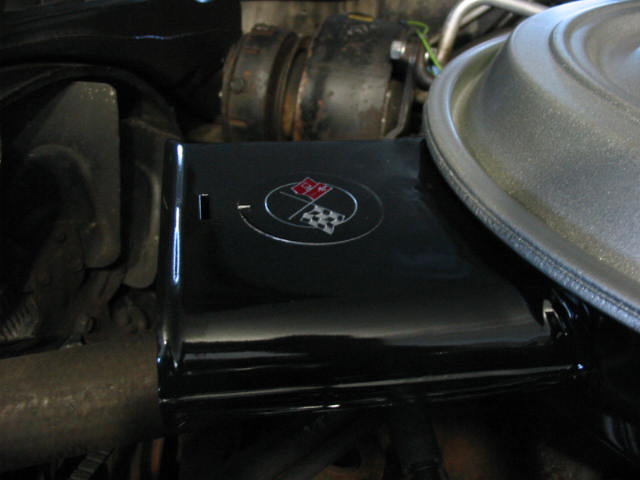
Original style air cleaner in place along with the cold air intake. I’ll pick up a custom flex hose to connect the two a bit later. AC is a problem for a dual snorkel setup as the AC pump is in the way for the passenger side connector for the same side snorkel. Must be a special single snorkel cold air feed. I’ll have to check that out as I plan to keep the AC.

Back to the door – I pulled the front and back vertical window runners and cleaned them up. I gave them a coat of white grease and used chain lube on the roller centre.

This little item was found in the door bottom. It is normally attached to the lower front of the door glass in a special hole made for it. The clip that holds it in place is missing. It is available but not just yet. I checked and the same item on the other window is in place so I’ll use it to get the drivers door back together.

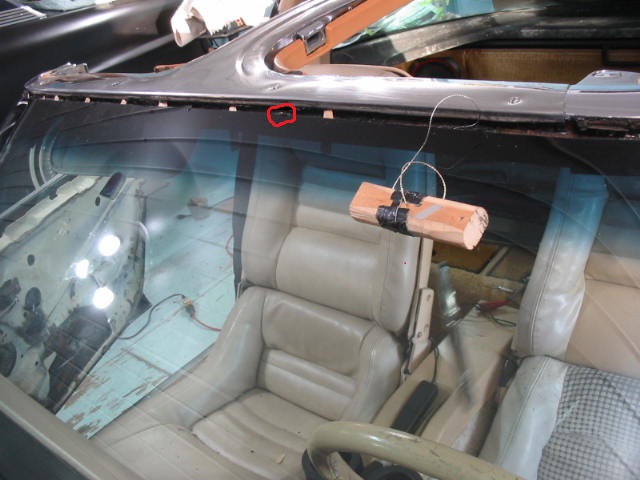
Time to replace the door seal. This screw and two at the rear top end of the door had to be drilled out. The tape didn’t save the paint. I used a piece of split rubber pipe for the back two and it worked better.

Next: getting the door seal in place and fixing the window supports.

Sport mirror mounting

This is what was under the original mirror on the left side. They turned out to be threaded inserts embedded in rubber that pushed in from the outside and locked in place. Neat way to design mirror mounts.

Once I got the two mounting nuts out this is what I have left.

Using a template I made up from the GM mounting instructions I located the two end points for the mirror studs and the centre point for the access hole needed for the mirror adjusting head. The left hole will be clear, but the right hole is very near the original mirror mounting hole. The fibreglass is quite thick at this point – a good 1/4″. I won’t be able to use a hole saw to make the 1″ hole in the center as the original mirror hole is in the way.

I drilled the right hand hole just enough to accept the mirror stud so that I would have the maximum material between it and the original mirror hole . I then drilled the left hole the full 3/8″ as per the GM mounting details.Even so I then had to use a round file the take a bit of material from the left of the right hole and the right of the left hole. I expected to have to drill through a metal support under the fibreglass, but the support is further inside. The support has two holes through the inner support bar to access the sport mirror studs and one to take the mirror adjuster head.

I decided not to drill a 1″ hole in the centre. Instead I used the sport mirror plastic gasket to mark the opening in the centre for the adjuster head. Using a drill and an electric dremel with a circular filing bit to remove the material in the centre opening until I had just enough room to slip the head through the hole.

With the front window channel removed I had clear access to the two mirror studs. After tightening up the studs I ran the adjuster cable through the two holes in the front part of the door which is designed to keep the cable away from the window as it moves. There is an access door in the front of the inner door panel to help get the cable through the two holes. Here the cable head is in place to be fitted into the door panel which I will do later when all the work on the door is done and it’s time to replace the panel.

The online forums talking about installing sport mirrors at times claim it to be a real chore. This could be the case if the window and the front window channel are in place. With them out is is fairly straight forward. The most difficult part is getting the new stud holes in the right spot. For that I located the mid point between the two access holes on the inner support frame and used that to locate the centre of the template on the outside – that put the holes for the studs in the correct spot along the top of the door. The template also located the two stud holes in the proper location below the ridge on the top of the door. There is some wiggle room where the mirror sits along the top, but it is critical that the positioning from the top ridge is close so that the mirror sits level and is not tilting up or down.

Next: Odds and ends and checking over the window glass.

Door locks

Time to install new door locks. The key for the original locks disappeared sometime in the past so I picked up a new set with a matching ignition lock. These are not anti-theft units so I’ll remove the anti-theft wiring and leave it to sit in the bottom of the door in case a future owner wishes to install the feature. It’s in a tight spot. I’ll remove the locking rod in the front of the photo so I can get my hand in.

New lock in place. I was just able to get my hand in to start both the big and small clips. I then use channel lock pliers to get the big clip in place and long needle nose pliers to coax to small clip into place. I did have to bend the slotted arm a bit to have a good fit to the lock actuating rod. These locks are a bit shorter than the anti-theft units which have a ground wire attachment on the inside end so the end of the lock reaches farther in the door.

Next: time to tackle the sport mirror.

And more door doings and other stuff

We had a warm day of +15 so I took the opportunity to get my painting done. I used Krylon gloss black from t he parts shop and it went on nice and should look good on the car. I used one coat of etching primer and three coats of black.

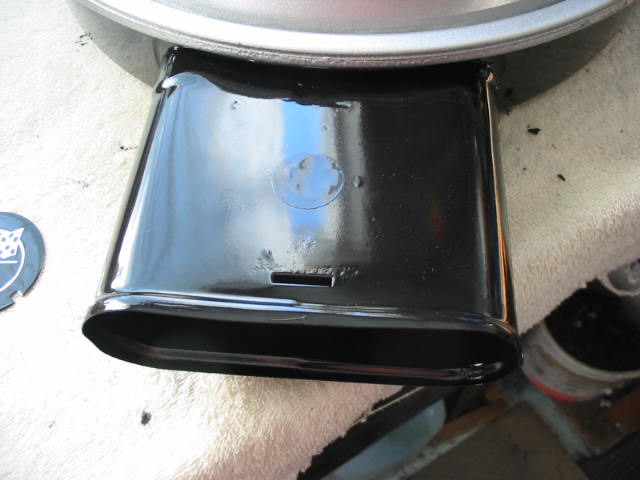
I also did the outside of the air filter. Came out nice and smooth. I did the top with silver metallic wheel paint for a bit of contrast. Again one coat of etching primer and three coats of black. The wheel paint only needed one coat.

Back to the door – The motor is installed after I secured the gear plate to the regulator arm with a nut and bolt. I’m using motorcycle chain lube on the motor gear and the gear plate. It sticks well and should remain on the gears and not drain or wear off.

Regulator and tracks all ready to be re-installed. The cover plate is back on the motor. I used white lithium grease in the tracks. It should last for many years before going hard. the regulator rollers seem good enough, but I’m thinking of ordering a replacement kit for all six rollers. In for a penny….

I already removed large mouse nests from both doors and here I find another tucked up towards the front.

Cleaned out and looking as it should!

Another part that came with the car, but wasn’t installed is the cold air intake setup. I discovered that it is meant to be attached to a dual snorkel air cleaner. I’ll likely stay with the single snorkel unit so I need to block off one of the connections.

I traced out the shape of the opening on a piece of paper and then used that to cut out the shape on a piece of 1″ pine. I attached it with four sheet metal screws and gave it a coat of black paint. It sits over to the right side of the behind the radiator and facing down so shouldn’t be too noticeable.

Next: door locks and sport mirror install

Door doings

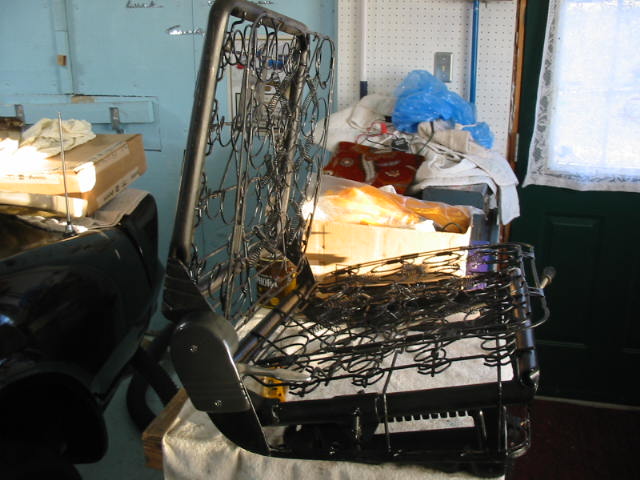
Door work will include repair of the regulator so the window will go to the top, replacing door lock and removing anti-thieft connections, installing a sport mirror with remote adjuster and finally replacing the damaged armrest and door handle escutcheon.

Easiest part is removing the door panel.

The manual doesn’t tell you to remove the window before trying to get the regulator out so it was a bit of a mix up getting it all out. OK in the end.

I locked the gear plate to the body with a nut and bolt as per the manual and then I removed the motor. The problem was obvious. Chewed up teeth at one end that stopped the window from reaching the top.

I removed the bolt holding the gear plate to the body, drove out the centre rivet with a suitable punch and then flipped it over to cut off the two rivets holding the gear plate to the regulator arm.

The new gear plate kit included two new pins to attach it to the regulator arm. The instructions with the kit say you can weld or rivet the new pins. I chose to use a peen hammer end to rivet the pins to the plate.

I re-riveted the spring mount pin also using a hammer peen. The two new pins are on either side of the spring mount pin – one is the pin to hold the end of the spring. I’ve spread some white lithium grease around where the spring sits.

I’ve cleaned away most of the old grease without putting the parts in a parts washer. The larger wheel has a leather seal which I didn’t want to damage. I’ll put it all together with lots of white grease. There is a little wear on one spot of the large gear wheel. I’ll try to re-install it so that the worn part is not a the top of the window travel.

Next; more door doings.

Moving along to the Power Steering

Air filter insides – I put on a coat of rust primer and then a coat of Tremclad gloss enamel. I find I can get a pretty smooth finish using a fine bristle brush and a bit of patience 😉 I’ll paint the outside with automotive spray bombs for a nicer finish as soon as I can get a day warm enough to paint in the barn upstairs.

Picked up a nice set of sport mirrors from Moland’s. I’ll paint these black and see if I can install them without doing too much damage 🙂

Also got a good used arm rest for the drivers side and two door handle escutcheons. I’ll paint them with fawn vinyl paint that matches the interior nicely.

Got all the hoses attached and the PS system tested out. I kept the pump disconnected and got the engine warmed up so it would stay at idle. I then connected the pump and started the car. It emptied out the pump reservoir right away and I needed to refill before testing.

I used this tool to set the nut on the end of the control valve (behind the silver cover in the shot above. I needed to turn in and out and find center which is hard with a ratchet. It was a bit tricky following the instructions in the manual. After a few tries I think I got it right. The manual says I should be able to move the piston rod in and out by hand When it was centered and I was able to to that. I then turned the steering from lock to lock a couple of times with the piston attached and the control valve nut adjusted and all seems OK.

Front wheels back on. I’ll do a final check on the steering when I get out again in the spring and do more adjustments on the control valve nut if needed.

Next: time to do some door work.

Fuel pump finished!

Using my handy Princess Auto punch set and a curved carving awl I cut out a new gasket from some thin fuel and oil resistant sheeting I got in a package of assorted gasket material from Fel Pro.

New pump rod in place with lots of vasoline to help hold it in place. Even so it kept slipping down after a short while – bloody gravity 😉

A thin bead of red high temperature gasket maker on both the gasket facing the engine and the cover plate. A little extra at the bottom where the oil accumulates before flowing back into the block.

All in place. Still a bother to get in place even using studs which had to be removed to get the proper bolts in place from outside in the wheel well via a gap in the fibreglass apron. I’ll be seriously considering a full time electric fuel pump when I do the engine rebuild.

My brass plumbing to eliminate the double curve in the fuel line to the carb. Just enough room to get the feed and return lines attached. I used aviation thread sealer by Pematex on all the threads.

I expected to have to pour gas down the carb a couple of times to spin the engine enough fill the carb and keep the running, but to my surprise it caught on the first try. Fast idle kicked in and I only had to up the idle speed once the engine warmed. The idle mix screws were initially set at 4 turns out. I increased that to 5 turns out which brought the engine speed up and smoothed the idle somewhat. I’ll wait until spring when I can take it out and really warm up the engine before adjusting the idle mix to get the highest steady vacuum.

I picked up a used single snout air cleaner from Moland’s Corvettes. I’m removing the cold weather stove heater setup for a cleaner look. Here it is sandblasted. I’ll do some sanding and hole filling before painting. The cover is already ready for painting.

Next: a bit more work on the air cleaner and then it’s time to get the power steering parts back on the car.

My eureka moment!

Part of the problem is the learning curve. This is the first Chev motor that I’ve actually done a lot of work on. I’ve done 6 and 8 Studebaker motor rebuilds and so didn’t think much about replacing a fuel pump. After poring over the shop manual for some inspiration I realized that it would be a problem should the fuel pump rod slip out of place. This engine has over 144k kms and is quite worn. Worn enough in fact that the fuel pump push rod did slipp down to the bottom of the fuel pump mounting cavity. So I removed the inner plate and there was the rod ready to fall out on the floor.

This is where the push rod should naturally fit. With it down the fuel pump lever was up against the rod and of course there was no pumping happening. As a result of the push rod being out of place it got bent slightly when I installed the fuel pump. I was able to straighten it enough, but there is a chance it will bind when the engine is hot. So off to the parts house today for a new push rod.

For some reason I can’t rotate the photo so the view is sideways.

A little work on the Stude – I noticed that when I drove into the garage the front end ‘clunked’ as it went over the ledge up onto the garage floor. While doing the grease job I noticed this. Two of the inner A arm rod mounting bolts had come loose. The nuts were almost off! That could have done some real damage. Only thing I can think of is that I missed torquing these two bolts on assembly. Easy fix with a good smear of blue locktite and a torque to 65 lbs. Oddly all these bolts lack lock washers and have to rely on the correct torque to stretch the bolts and keep things tight.

Next: time to get the fuel pump on and the Chevy started:-)